Friday, November 20, 2015

Africa Confidential

Resultado de imagem para africa confidentialPresident Filipe Nyusi's new era – a decisive break with the policies and personalities of ex-President Armando Guebuza – has begun with an apparent financial disaster. His officials report that the Treasury has far less money than had been expected. One unofficial but conservative estimate put the shortfall at about US$900 million, much of it anticipated tax revenue from oil companies which may have been illegally waived. Some say this depletion of the exchequer is an act of revenge by supporters of Guebuza intent on damaging Nyusi's prospects. Insiders speak of a massive increase in pillage from within the highest circles of government as Guebuza's term ended, some of it so crude that it could have legal consequences. The estimated $725 mn. cost of the Catembe Bridge in Maputo, for example, is double what it should have been, we hear, in order to accommodate massive kickbacks. As well as the missing millions in public funds, there is also believed to be a vast sum missing from the proceeds of the Ematum bond (AC Vol 55 No 3, Donors up in arms). Around $600 mn. of the cash raised on the $850 mn. bond, which is private finance but is backed by a state guarantee, has disappeared, according to a source close to the company. Ematum made a $10 mn. loss in its first year of operations, and with no means to pay the high monthly interest on the bond, the state may end up stuck with the bill. Such is the growing concern about Ematum that Maputo insiders believe it was no coincidence that both Nyusi and Prime Minister Carlos Agostinho do Rosario failed to appear at an Ematum event on 9 April at which they were expected. The new Minister of Economy and Finance, Adriano Maleiane, is demanding answers from Guebuza's government and in particular from ex-Finance Minister Manuel Chang, we hear (AC Vol 56 No 2, New cabinet brooms and Vol 54 No 22, The mystery ship deal). There is widespread speculation in the city that, even if the new government does not want to stir up trouble within the governing Frente de Libertação de Moçambique (Frelimo), the financial hole is so vast that it may have no option but to prosecute members of Guebuza's government and their friends in order to recover some money. At the same time, the new team at the Finance Ministry is said to want a re-assessment of a multimillion dollar tax break granted to the Italian oil giant ENI (Ente Nazionale Idrocarburi), which Guebuza negotiated privately (AC Vol 56 No 5, A shot at devolution).

Clean break
Nyusi's accession to power and Guebuza's resignation as Frelimo Chairman mark the most abrupt break in continuity at the top since Independence in 1975 (AC Vol 56 No 7, A farewell to Armando). Until the resignation, there were fears that his barely concealed fight with his successor as state President could derail the country's development plans. His way clear and his battle won, Nyusi must now make good on his promises of change, Maputo pundits say. Since his inauguration as national President in January, his predecessor had tried to interfere with his orders to ministers and to prevent him from negotiating personally with the leader of the Renamo Party (Resistência Nacional Moçambicana), Afonso Dhlakama. Nyusi's serenity in the face of this onslaught won him respect. During Frelimo's three-day Central Committee meeting which opened on 26 March, Guebuza dug his own political grave as he alienated former allies so thoroughly that they turned on him on the final day. He fell on his sword the following morning, Sunday 29 March, and Nyusi was then voted in as the new Party President. He lost only three votes – one blank and two spoiled – which we hear were those of Guebuza, his wife Maria da Luz Dai Guebuza and their businesswoman daughter, Valentina da Luz Guebuza. Word about the meeting has recently emerged. Although Guebuza's friends warned him that he needed to preserve his dignity – and in all probability his business interests – by surrendering
gracefully, he was apparently blind to the danger he was in. As a result, the backlash deeply shocked him as former loyalists such as a former Foreign and later Environment Minister, Alcinda Abreu, angrily backed earlier accusations that Guebuza controlled the party through intimidation. In the end, it was his hubris that weakened his judgment and left him isolated. The independent newspaper Savana summed it up in a front-page headline: 'Abandonado'. The accompanying photograph showed a crestfallen ex-President. The long view sees Guebuza's downfall as a sad end for a leader who brought in improvements in infrastructure, greater foreign investment and increased professionalism amongst state officials. However, this gave way to increased insecurity and violence as weak and corrupt institutions undermined business and failed to spread the benefits of economic development to the population. Guebuza surrounded himself with people widely seen as mediocre sycophants, such Edson Macuácua and party Spokesperson Damião José (AC Vol 55 No 22, Nyusi's rocky road). José has been sacked and there is talk in the party of replacing staff on the Secretariat.
Renamo profits
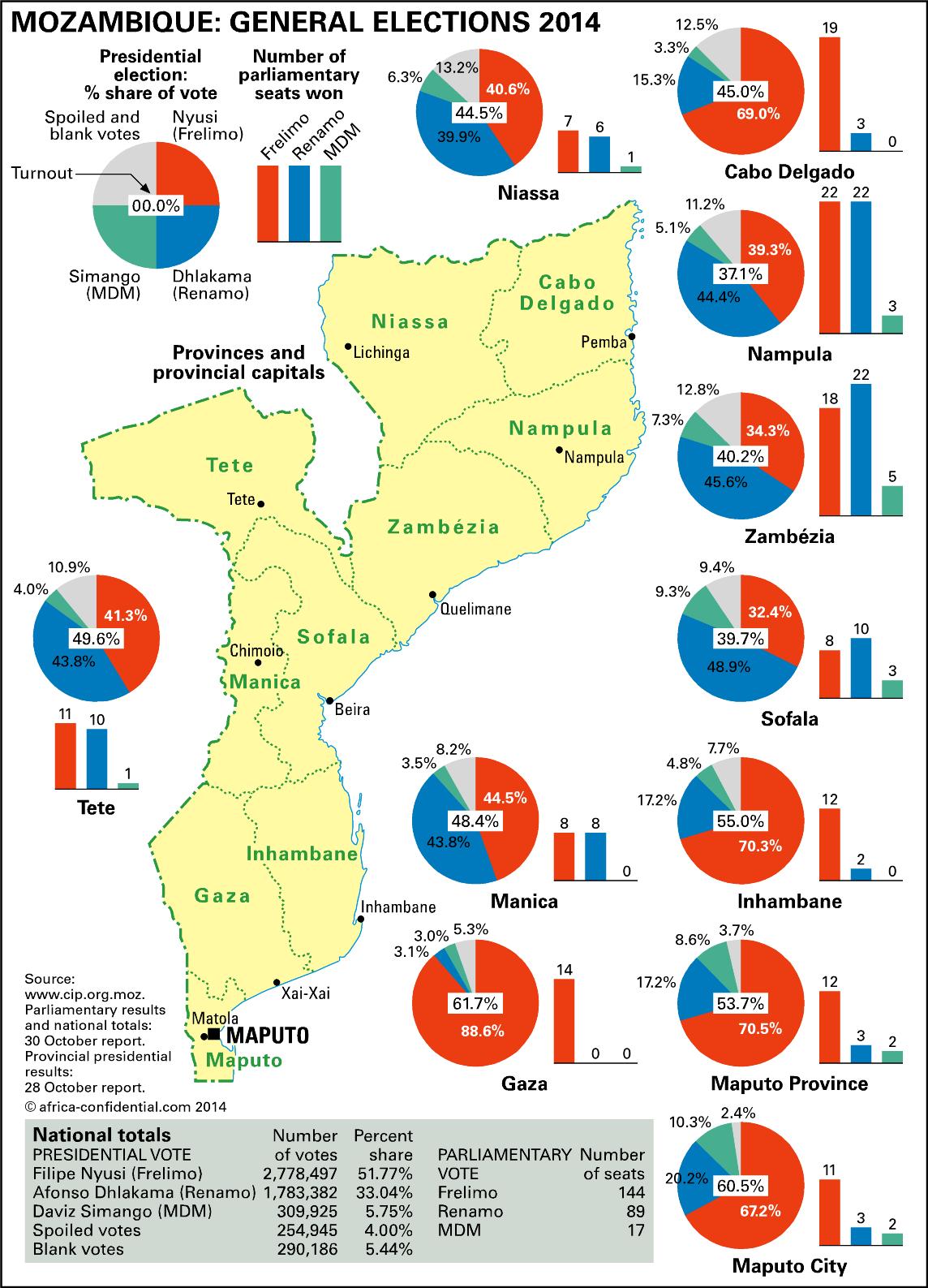
Rescuing the state finances will be one of Nyusi's greatest challenges, along with the seeminglyimpossible task of achieving lasting peace with Renamo. Buoyed by the internal conflict in Frelimo,Dhlakama seems resolved to escalate his demands. Nyusi is inclined to negotiate but there will be a limit to what he can give. Frelimo's fraud during the last elections was extremely widespread, most now agree, but Dhlakama's claims of outright victory remain implausible (AC Vol 55 No 21, Frelimo wins, Renamo revives). It is unlikely Renamo would be allowed to rule in all the provinces that voted its way and Frelimo members are not the only ones who see dangers in regional autonomy. Importantly, however, Nyusi does not have the visceral intolerance of Renamo and Dhlakama that Guebuza displayed. He could be a more reasonable and skillful negotiator. Without the intransigence born of a fear of losing face, the two sides may make better progress. The pressure on Nyusi to deliver is now great. As Guebuza found out, the disappointment of your friends can be more dangerous than the wrath of your enemies. Nyusi faces the future with immense popular good will but vast expectations, too.
Copyright © Africa Confidential 2015

http://www.africa-confidential.com

TELECOMS BILL WILL PENALISE.......

Resultado de imagem para escutas telefônicasThe government bill on telecommunications which passed its first reading in the Mozambican parliament, the Assembly of the Republic, on Wednesday is not intended to open the door to illicit wire-tapping, the spokesperson for the parliamentary group of the ruling Frelimo Party, Edmundo Galiza-Matos Junior, told reporters on Thursday.The main opposition party, the former rebel movement Renamo, had claimed that the bill might allow any official to order phones to be tapped, and for this reason voted against the bill.Speaking at a Maputo press conference, Galiza-Matos claimed that the bill went in exactly the opposite direction to that claimed by Renamo. Far from facilitating wire-taps, it increased the penalties for illicit interception of communications.The bill is an amendment of the 2004 law on telecommunications. Galiza-Matos pointed out that the clause on confidentiality of communications has been strengthened. The 2004 law states that “confidentiality is guaranteed”, but the new bill goes somewhat further, by declaring “it is obligatory to guarantee confidentiality”.The article which Renamo claimed opens the door to widespread wire-tapping, in fact increases the penalties for unauthorized wire-taps, Galiza-Matos said. If the bill is enacted into law, the penalty will be between eight and 12 years imprisonment plus a fine of up to two million meticais (about 42,500 US dollars).Wire-taps could only be authorized by “the competent authorities”. But this did not mean that any official could declare himself competent to order phones to be tapped. Galiza-Matos said that “the competent authorities” are defined in law, and that, under the current legislation, courts or the public prosecutor’s office are the bodies which can approach the regulator, the Mozambique National Communications Institute (INCM), and ask for specific phones to be tapped.

PUMA ENERGY OPENS TWO NEW TERMINALS

The international fuel distribution company Puma Energy has opened two new terminals in the southern Mozambican city of Matola. The terminals consist of eleven storage tanks holding bitumen and fuel.The facilities, which employ 77 Mozambicans, were inaugurated on Thursday by the Minister of Mineral Resources and Energy, Pedro Couto. They brings the company’s total capacity in Mozambique to 275,500 cubic metres of bitumen and fuel.According to the Chief Operating Officer for Puma Energy Africa, Christophe Zyde, “Mozambique is a very promising market in Africa today. We have confidence in the country’s long-term commercial opportunities as well as the country’s strategic location to answer the supply requirements of Southern Africa”.As a result of the new facility Mozambique will no longer rely on bitumen imports from neighbouring countries.

NYUSI CALLS FOR RESTRAINT IN DISARMING RENAMO

Resultado de imagem para NyuseMozambican President Filipe Nyusi on Thursday called for restraint in the disarming of the illegal militia of the former rebel movement Renamo.Speaking in Moamba, about 60 kilometres northwest of Maputo, during a graduation ceremony for newly trained prison guards, Nyusi put the brakes on the compulsory disarmament of Renamo, calling instead on the Renamo gunmen to hand over their weapons voluntarily.“I am using this podium to order restraint in compulsory disarmament, allowing everyone to hand over voluntarily that which they think they should not possess”, said Nyusi. “Above all, this is to allow us to work and to enter into dialogue, in the spirit of trust and mutual willingness”. “If there is no willingness on the part of all those involved in the peace process, we are aware that this peace may not happen”, he warned.“I am ready to speak with anybody, including the Renamo leadership, in order effectively to re-establish peace”, Nyusi declared. “This is so that we can find solutions that will calm Mozambicans”.He once again appealed to the Renamo militiamen to hand over their guns, “so that the ownership of weaponry is reserved only for the defence and security forces, based on a spirit of concord”.This emphasis is quite different from that given by Interior Minister Jaime Monteiro, when he addressed the country’s parliament, the Assembly of the Republic, on 4 November. Monteiro then had promised “to strengthen the collection of weapons that are in illegitimate hands”, and promised that this collection would continue “until the last firearm in unauthorized hands is collected coercively or handed over voluntarily”.Nyusi was clearly suggesting the re-opening of talks with Renamo. But it was Renamo, on the instructions of its leader, Afonso Dhlakama, which in August unilaterally broke off the dialogue with the government that had been under way since April 2013.Dhlakama himself publicly rejected the invitation from Nyusi, issued in late August, for a face-to-face meeting in Maputo. Currently Dhlakama has dropped off the radar – he has not been seen in public since 9 October, when the defence forces disarmed his bodyguards in the central city of Beira.Addressing the newly trained prison guards, Nyusi called for selfless dedication to the tasks entrusted to them. He reminded them that “the people are with you in the mission you will be carrying out as from today”. About 600 guards from all over the country graduated from the course, which lasted for six weeks.

Thursday, November 19, 2015

Triton Minerals raises funds for graphite

clubofmozambiqueTriton Minerals intends to raise 11.3 million Australian dollars through a share issue in order to continue graphite exploration in northern Mozambique, the Australian company said in a statement Thursday.Under this initiative, GMP Securities Australia agreed to issue shares of up to 4 million Australian dollars through a set of standard conditions in contracts of this kind.The funds raised will be used to further define the location of the graphite deposits in Ancuabe and in Monte Nicanda, both in the province of Cabo Delgado, northern Mozambique.The funds will also be used to extend the definitive feasibility study, to include the P66 area in the Monte Nicanda concession and the partnership with a Chinese company for construction of a graphite processing plant in Mozambique.Triton Minerals also reported that some of the funds raised are expected to be used at the beginning of construction of the processing unit, in partnership with China’s Yichang Xincheng Graphite.

Five million euros

The European Union (EU) is to donate five million euros to support the activities of civil society organizations, Deputy Minister of Foreign Affairs and Cooperation Nyeleti Mondlane announced yesterday.Speaking at the signing of the agreement in Maputo, Mondlane described the donation as "dedicated to supporting the institutional capacity of civil society organizations".Initially, 11 civil society organizations will benefit in an initiative that will fund small projects aimed at helping local communities overcome the problems they face."The program will help improve governance and citizenship in Mozambique by strengthening partnerships and mutual responsibility between public authorities, non-state participants and citizens," the Mozambican deputy minister said, praising the EU’s support of Mozambique during the 30 years of its presence in the country.Mondlane called on beneficiary organizations to give greater attention to project implementation, especially as Mozambique has "huge potential" in relation to the quality of initiatives.The head of EU delegation, Sven Kuhn von Burgsdorff, highlighted the importance of civil society for the peaceful resolution of internal conflicts at a time when the country is experiencing political and military tension, saying they were crucial in defending the interests of the population."A recently published study traces the rapid growth of Mozambican civil society and its impact on national policies, a very important element," said von Burgsdorff, adding that continuing support would strengthen their capacity to assist.

Ambassador to French Citizens in Mozambique


Message from the Ambassador to French nationals in Mozambique:
Resultado de imagem para Bruno Clerc
Today, France is in mourning. Terrorist attacks of unprecedented proportions took place in Paris last night. There are a considerable number of victims. As stated by the President of the Republic, "It is a horror. (...)This is a terrible ordeal which once again assails us. We know where it comes from, who these criminals are, who these terrorists are. What the terrorists want is to scare us. There is dread, but in the face of this dread, there is a nation that knows how to defend itself.” There is, in these tragic moments, the moment of compassion and solidarity. Our community’s thoughts go to the many victims of these cowardly attacks. There will also be time for reaction and to move on. Our country will, once again, stand up and lead the fight for freedom and democracy.
The state of emergency was declared throughout the national territory, border controls have been restored, an extraordinary cabinet meeting was convened in the night.
I want to assure you that all precautions are taken to protect our community and our operations in Mozambique. The Embassy will keep you informed of any special safety instructions: at this time, each one’s vigilance is certainly in order.
We have also received testimonies of solidarity and sympathy from many personalities: they are warmly thanked.
I invite you to reflection, solidarity, and serenity in face of these attacks that want to destabilize us. United and gathered around our values and our ideals we will know how to face this.
Long live the Republic, long live France!

Bruno Clerc

Ambassador of France in Mozambique 

Wednesday, November 18, 2015

Moatize / Macuse

It is expected in the coming days the launch of the tender for the construction of the railway line between Moatize , Tete province, and Macuse ( Zambézia ) , in central Mozambique .The chairman of Zambezia Development Corridor , Abdul Carimo , "if not arise last minute constraints the field work should start in February next year ."Abdul Carimo also said that the project also provides for ' the construction of a deepwater port in Macuse region' located in Namacurra district , " and even the implementation of a railway line about 500 kilometers" , which will end the coastal area of Sopinho in Nicoadala district , Zambezia province.The works are estimated to cost 3.5 billion US dollars and , in a first phase, will employ over 10,000 people.

Friday, November 13, 2015

Mozambique hit by commodity price fall

Cranes tower over buildings across Maputo, from new office blocks to a huge Chinese-owned five star hotel. Industrial drills and grinders add to the cacophony emanating from the city’s increasingly traffic-clogged streets.The capital of Mozambique bears all the hallmarks of a city in the throes of a boom. But beneath the ‎surface is an economy under stress, hit by the collapse in commodity prices and global economic volatility that is blighting some of Africa’s brightest prospects.“It will be tough,” says Salimo Abdula, a prominent businessman, bemoaning the recent marked slowdown in economic activity.For much of the past decade, Mozambique has been one of the continent’s hottest investment destinations, largely due to the discovery by oil companies Anadarko and ENI of vast offshore gasfields with the potential to bring in billions of dollars of investment and transform one of the world’s least developed nations into one of its top producers of liquefied natural gas.But just as the slump in oil and metal prices has hit Africa’s top commodity exporters, from Nigeria to Zambia, it is hurting poorer nations hoping to be among the next generation of commodity exporters. 
Resultado de imagem para maputo capitalThe trend is radically altering the narrative of the Africa growth story — one of the few bright spots in the global economy in recent years.Illustrating the travails Mozambique faces, the International Monetary Fund last week announced it had agreed to loan the government $286m. It still forecasts growth of 6.3 per cent for Mozambique this year — far healthier than its estimate of 3.75 per cent for sub-Saharan Africa but markedly less than the country has been used to.“Mozambique is currently experiencing an external shock associated with the drop in commodity prices, lower growth in trading partners, and delays in investment associated with large natural resource projects,” the IMF said.The country’s annual growth rates have been in excess of 7 per cent in recent years, and the congested streets of Maputo pay testament to the trickle-down effects for the city’s small but growing middle class — the number of vehicles imported annually has nearly trebled to more than 52,000 over the last decade.
chart: Mozambique GDPThe consortiums led by Anadarko and ENI were expected to announce their final investment decisions on the gas projects this year, but these are now expected to be delayed until 2016. A nascent coal sector has been hit by infrastructure bottlenecks and falling coal prices.The impact of the economic slowdown has been particularly conspicuous in the construction and real estate sectors that were driving Maputo’s boom.
“Suddenly foreign investment is decreasing [and] the state is highly in debt,” says Andre Vilas Boas, country manager of Soares da Costa, a Portuguese construction company. “We are in an economy with no liquidity and we are waiting.”

Although bankers and businessmen say they are optimistic that the economy will rebound, the country faces a number of challenges.Like other emerging market currencies, the metical has depreciated sharply this year, falling about 30 per cent against the US dollar, hurting importers in a nation dependent on goods from abroad. The government’s foreign reserves have shrunk by a quarter to $2.3bn and it is battling a budget deficit that hit 10.4 per cent of gross domestic product last year.Mr Abdula, head of Intelec Holdings, which has interests in a variety of sectors, says a slowdown in government spending and increasing delays in its payment of bills is having a ripple effect across industry.“If they pay, they pay very slowly, but it affects all the systems because it’s like a cascade,” says Mr Abdula. 
A general view shows buildings under construction in Maputo on the eve of the 40th anniversary of Mozambique's independence from Portugal on June 24, 2015. Upon gaining its independence, Mozambique directly entered a 16-year-long destructive civil war which didnt allow the young Mozambican state to maintain its infrastructure. Mozambique and Angola this year mark four decades of independence from Portugal, with robust economic growth rates buoyed by abundant natural resources giving the southern African nations reason to celebrate. AFP PHOTO / ADRIEN BARBIER (Photo credit should read ADRIEN BARBIER/AFP/Getty Images)“Many of the companies have faced this cash flow [problem]; I don’t know how long they can hold.”Domestic factors also play a role in the changing outlook. The government’s decision two years ago to back a controversial $850m bond to set up a tuna fishing company has left it responsible for $500m of the company’s debt, heaping additional pressure on its meagre resources.Businesses are also grappling with a shortage of dollars. Imports have continued to grow at 17 per cent year-on-year but exports have stagnated.The knock-on effect is visible around the capital. Hotels that were until recently enjoying 90 per cent or higher occupancy rates are now around half full; rents and property prices have tumbled.“It’s difficult for some developers to fund the buildings.
Resultado de imagem para maputo capital Previously you could secure 70 per cent off-plan, now you can secure 5-10 per cent off plan,” says Adrian Frey, the Mozambique head of real estate group Pam Golding. “It’s an important learning curve for Mozambique that it’s not always going to go up.”Few doubt the gas projects will proceed eventually and executives remain optimistic about Mozambique’s potential, but for now the hype of recent years has been replaced by a degree of uncertainty.“We believe it’s a question of time,” says Ismael Faquir, country head of Ernst & Young. “But of course looking at the price of commodities, everyone is worried because we started the discoveries when the price of oil and commodities was high, and today everything that we have has had a significant decrease in price.”

Aga Khan Network opens architecture

Resultado de imagem para aga khan maputoThe Aga Khan Development Network in Mozambique opens an exhibition of architecture projects today in Maputo, as part of an initiative based on its global premium architectural foundation. The exhibition, called ‘Building for a Better Life’, brings together 20 architectural projects selected from a field of 114 in a contest whose first prize divides around US$1.9 million dollars among the top five finalists."The intention is to reward projects that set new standards of excellence in architecture, planning practices, historic preservation and landscape architecture," Nazim Ahmad, Ambassador of the Aga Khan Development Network in Mozambique told LUSA.The competition has taken place every three years since 1977, with the exhibition being the first initiative promoted by the Aga Khan Trust for Culture in Mozambique. It will be open to the public from 4 to 8 November at the Aga Khan’s historic building at the juncture of Avenidas 24 de Julho and Albert Lithuli in Maputo."Through the project, the Aga Khan network aims to publicize the prize, with the aim of identifying projects in Mozambique that could be nominated for the award," said Ambassador Ahmad, adding that the network would partner with the Ministry of Culture and Tourism, civil society and architecture schools in the country in forwarding their agenda."The essence of the Aga Khan Award for culture is to examine, analyze and understand the dynamics of physical change in Islamic societies," said Ahmad, quoting the leader of the foundation.At the official opening of the exhibition, held on Monday, the Minister of Culture and Tourism, Silva Dunduro, said that the Mozambican government will continue to foster public and private partnerships for the development of cultural tourism, adding that the initiative would "augment intellectual interest" in the field of architecture."The award has celebrated, since 1977, the cultural and artistic value of architectural design," said the Mozambican minister, highlighting the network;’s contribution to human development in Mozambique."These features demonstrate the commitment of this great institution to individual growth in the first place, and the growth of societies," he said, noting that each work showcased carries within it both a history and a culture.