
Wednesday, November 25, 2015

Price rises could create social tensions in Mozambique

Resultado de imagem para mario machungoFormer prime minister Mario Machungo said on Friday that the increase in prices could create social tensions in the country, and advocated greater collaboration between the banking sector and the Bank of Mozambique "to stabilize the currency".Speaking to Lusa in Oporto on the sidelines of the Portugal Africa Foundation’s “Africa, Ways of the Future" conference, Machungo said he found the price increases worrying, as they "could create social tension"."The metical worries me. It has devalued tremendously recently and this is worrying for all of Mozambique", he said.According to its former president, Millenium bim, Mozambique’s largest bank, could help offset the external shock that the economy is suffering by "adopting monetary policies advocated by the Bank of Mozambique".The bank must "cooperate with the central bank to stabilize the currency," he said.Machungo also said that the bank "has to be prepared to implement the envisaged measures" to reduce credit acceleration, relieving imports and pressure on the metical, but, he argued, "demand cannot be stopped abruptly"."The economy – businesses – need credit to sustain employment and work. The bank should not be pressured to do it in one day; it must have time to do it," he said.Asked whether he agreed with the austerity measures suggested by the International Monetary Fund (IMF) and already implemented by the Mozambican government, Machungo said that he has "little knowledge" of the IMF proposals, but said that he accepts measures aimed at "solving problems of misapplication of funds, of misuse, which do not promote development.
Resultado de imagem para Price rises could create social tensions in Mozambique"The IMF said on Wednesday that adjustments and structural reforms to control threats facing the economy of Mozambique were inevitable, while still believing that the situation is temporary."There is need for adjustments to stabilize the macroeconomic situation," IMF representative in Mozambique Alex Segura said during the presentation in Maputo of an IMF report on the economic outlook for sub-Saharan Africa, entitled "Dealing With Dark Clouds."According to Segura, the "external shock" facing the region caused by the slowdown in emerging economies and the normalization of US monetary policy and change in China’s development mode, the drop of the price of raw materials, will require tax adjustments and a credit slowdown in Mozambique, which has "experienced excessive expansion mainly financing consumption and low employment sectors".To contain the impact of the external shock, the IMF advocates Mozambique adopt a policy of moderate inflation, debt sustainability and stabilized metical depreciation levels.Mozambique and IMF in October negotiated a loan of US$286 million (EUR 263 million) to cover the sharp devaluation of the metical, falling foreign currency reserves, rising inflation, reduced foreign investment and foreign aid and rising debt. 

‘‘pose no threat to overall stability of Mozambique”

Resultado de imagem para ‘‘pose no threat to overall stability of Mozambique”Answering a question from Radio Moçambique about the collecting of weapons in the hands of Renamo and other unauthorized individuals, the Minister of the Interior, Basilio Monteiro, said on Friday that weapons outside the control of the state in Mozambique pose no threat to the overall stability of the country.The Interior Minister previously said, at the closing session of the Permanent Joint Commission of Defence and Security between Malawi and Mozambique, that at any time the government may come to the conclusion that the compulsory collection of weapons is not justified if people are giving them up voluntarily.The meeting of the Permanent Joint Commission took place in Mangoche, Malawi, this week and, according to Monteiro, reached consensus on maintaining a peaceful environment and better managing the common border.

"culture of non-violence"


clubofmozambiqueMozambican President Filipe Nyusi on Monday urged the country’s media to reproduce the culture of non-violence, dialogue and permanent debate, in order to contribute towards maintaining and consolidating effective peace.Nyusi made this recommendation when he opened a national conference on the role of the media in combating violence and promoting peace, organized by the Higher Mass Media Council (CSCS), the watchdog body on press freedom and the right to information established under the Mozambican constitution.Nyusi stressed that to block the culture of violence it is never enough simply to use the police or other coercive means.“You have to respond with a culture of non-violence, a culture of dialogue and open and permanent debate”, he said. “This culture must be reproduced day after day in the mass media. We have to speak of peace not just when we are directly threatened. True peace is a culture of listening and constructive dialogue. Each newspaper and each radio or television station should be a classroom where we learn citizenship, where we learn that we belong to the same family”.
Resultado de imagem para "culture of non-violence"Nyusi noted that various forms of violence exist in societies, some more visible, others more hidden and silent. But all should be denounced – including the violence against albino citizens, against women, against widows, against the elderly, or against children. All of these should be a matter of permanent concern to the media. Nyusi urged the media not to stop here, but also to publicise specific cases of exemplary and positive behaviour, such as the countless people who set examples of bravery in the struggle against crime and violence. The media, he continued, should also speak of examples of solidarity and assistance for the more vulnerable strata of society, and divulge the merits of all those who are building a more peaceful, cooperating nation, based on moral values.Because effective unity will lead to a climate more favourable to peace, the President promised that, in his own speeches, he will continue to proclaim the need for a united and cohesive nation.“I shall continue to defend a nation immune to any attempt at division”, said Nyusi. “So that this message becomes part of the life of each Mozambican, it must be converted into specific episodes, into stories of people who have a name and a face”. 
For his part, CSCS Chairperson Tomas Vieira Mario declared that the most important theme on the national agenda is the end of violence in society, particularly politico-military violence, and the restoration of an effective and lasting peace.“We know how relevant the role of the media is”, he added, “since it is through the media that practically the entire narrative of violence and peace reaches the public, in the cities and the countryside, inside the country and abroad. It is through the reporting in the media that public opinion is built about the profile, objectives and strategies of the parties in conflict”. Vieira Mario asked whether it was possible, in a context of pluralism, to have a unanimous editorial line on the media with regard to conflict. “Perhaps not about the conflict in itself”, he continued, answering his own question, “but certainly about what would be consensually desirable for the good of all”. 

600 students miss exams in Zumbo

More than 600 second-graders from Zumbo, Tete province, central Mozambique, did not sit their annual exams due to political instability and the military situation in the region, local authorities announced yesterday.Jorge Vilanculos, director of the Education, Youth and Technology District Services in Zumbo told Radio Mozambique that the students’ parents and guardians had fled to neighbouring Zambia as a result of the threat of clashes between Renamo (Mozambique National Resistance) and the government’s defence and security forces.Vilanculos said that the students affected are mainly in Cassinga and Mbadua and that he has sent out teams to talk to local community leaders about the situation.The political and military instability has also led to school closures and student absenteeism in Tsengano and Moatize, Tete province, and Morrumbala, Zambezia.The renewed tension is caused by Renamo’s refusal to recognize the results of the general elections of October last year and its proposal to rule in the six provinces where it claims victory, threatening to seize power by force if necessary.In recent weeks the worst political and military tension since the Comprehensive Peace Agreement signed in 1992 in Rome ended 16 years of civil war has been sparked by a police operation to disarm the remaining Renamo combatants. However, on Thursday, Mozambican President Filipe Nyusi asked the defence and security forces to suspend ('opt for ponderation') the disarmament process, and the following day, Interior Minister Basilio Monteiro said that the weapons outside state control pose no threat to the overall stability of the country.Renamo leader Afonso Dhlakama has not been seen in public since October 9, following the siege, disarmament and disarmament of his personal bodyguard at his home in Beira, in the centre of the country.

"I'd rather be a tailor"


Resultado de imagem para instrumentos musicaisArtists close to the Frelimo party in the northern province of Nampula are complaining that they have not been paid for their performances over the 45-day long electoral campaign which brought the party and Filipe Nyusi to power.A considerable number of artists, including musicians, say they have still not been paid for performances given during the 2014 election campaign.Belo dos Santos, known as "3C" and with a 12-year artistic career behind him, confesses that he has not returned to the stage because he is disappointed with the government attitude and particularly with Frelimo who he says have deceived him several times."I stopped recording new songs a long time ago. I lost the will. There has to be that will for the musician to continue to give his best. I feel like I am screaming, but to no avail. I prefer being a tailor."The artist says that if he ever goes back to recording, it will be for him and his family.Germano Ernesto, popularly known as Nico, says Frelimo made promises to him too, but they turned out to be false."The campaign is over and we are waiting for the 'big cake' that had been promised. We musicians did not get to make demands about what kind of 'cake', but we understood that this ‘gift’ would be the sound system. When the campaign ended, the current governor of Sofala province, Helena Taipo [then head of the Frelimo electoral office in Nampula City] went off without telling us anything."Nico also said that the former Labour Minister was forced, after a prolonged peaceful strike held last February by 40 musicians, to sign a check for 100,000 meticais (about 2088 euros), to honour the commitments made by the party with the artists who participated in several activities in the run up to elections."I got 4,000 meticais for 45 days work, when usually I get at least 5,000 meticais for a show," Nico laments.The musicians say they will not press Frelimo for payment. Nico explains: "Things are already boiling because – I cannot hide it, we musicians are already being conquered [by the opposition]."Germano Ernesto believes that the Frelimo government has contributed to the depreciation of Mozambican culture precisely because of this lack of incentives. "People no longer listen to Nampula music. The people have started to listen to Angolan music. There was a time when Nampula music was strong, but it declined because they did not embrace the musician himself. Musicians need affection," Ernesto says.Leonel Namuquita, however, Frelimo first secretary in Nampula city, neither confirms nor denies any conflict between his party and the artists, but says that problems are being solved gradually."I believe that the commitments will be met. We cannot deflect attention from the 2015-2019 five-year program. There are priorities. So this is the challenge for the wellbeing of the people of the city of Nampula," says NamuquitaLast week, at least 13 musicians protested outside the Nampula district government building, demanding payment for a show celebrating Independence Day in June. 

Friday, November 20, 2015

1 million dollars to justify

FIFA suspended financial support to the Mozambican Football Federation (FMF) as one of its 210 affiliates worldwide due to lack of reports which justify the funds allocated in the year passado.O fact was made known yesterday in Maputo, the senior manager of development programs for Africa that institution which governs world football, Zelkifli Ngoufonja (1), at the end of a three-day visit to the country, during which learned about the functioning of the FMF, and meet their new cast. 
Resultado de imagem para Zelkifli NgoufonjaAccording Ngoufonja, as is mandatory rules, FIFA requires the annual statement of accounts and activities to its members, and must be submitted by 31 March each year, the FMF did not. Lately, FIFA requires not only the reports of the fund that allocates, but also of those who canvass their members during the year. "Now we require the reports of global accounts, not only the money we provide. Mozambique still not given us their supporting, so we suspended the funding. The money for the FMF exists, but requires only the clarification of last year's accounts, "explicou.Este year FIFA has allocated one million and fifty thousand dollars each associated with a substantial increase and that according to the Software Development Manager for Africa is justified by the dispute of qualifying for the World-2018, which will take place in Russia. "In all, we added $ 500,000, plus 300,000 for the bonus. Annually generally FIFA allocates $ 250 thousand to affiliates, "continuou.
Resultado de imagem para Zelkifli NgoufonjaThe face this embarrassing scenario for the FMF, in particular, and for the national football in general, the new cast was obliged, first, to do an internal audit, the results of which the chairman of the Board, Alberto Simango Jr.(2), declined to reveal and subsequently external audit was requested. "We hope the results of this audit, and all believe that will come out soon. After that, and if all is well, we will release the funds for the FMF, "insisted Zelkifli Ngoufonja, raking that FIFA wants to continue to support our country in the development of football in its various aspects.

Good weekend

GERMAN FOREIGN MINISTER

Mozambican Foreign Minister Oldemiro Baloi on Thursday received in Maputo his German counterpart, Frank-Walter Steinmeier, with whom he discussed strengthening the ties between the two countries. “During the meeting, we expressed our desire to strengthen relations of cooperation and friendship between the two states and people”, Steinmeier told reporters The German minister, who is on a two day visit to Mozambique said that Germany wants to boost business contacts with Mozambique in various areas of activity. 
Resultado de imagem para Frank-Walter Steinmeier“We want to identify more business opportunities with Mozambique because we believe this is a country of opportunities”, added Steinmeier.“This is my fifth visit to Africa in two years, as Foreign Minister”, he added, “and this visit comes at a time when there are conflicts in the Middle East, and also here in Mozambique, between the government and Renamo, the largest opposition party. We hope that the political leaderships achieve consensus”. For his part Baloi said that the relations of friendship and cooperation between the two countries are healthy, and increasingly promising, since Germany is continuing to invest in Mozambique.“In these talks, we discussed bilateral matters, and the existing relations between the two countries which are illustrated by the parliamentary, business and scientific components to this visit”, Baloi added. “We also looked at what is going on in the world, in questions of a universal nature, such as questions of terrorism, the environment, the reform of the United Nations and the international economic situation”.Germany has withdrawn from the group of donors and financial agencies known as the Programme Aid Partners (PAPs) who provide part of their aid to Mozambique in the form of general budget support.Despite dropping out of budget support, Germany remains a major donor, providing around 60 million euros (about 64.3 million US dollars) a year, to various sectors. Of this sum, 15 million euros is destined to education.

Africa Confidential

Resultado de imagem para africa confidentialPresident Filipe Nyusi's new era – a decisive break with the policies and personalities of ex-President Armando Guebuza – has begun with an apparent financial disaster. His officials report that the Treasury has far less money than had been expected. One unofficial but conservative estimate put the shortfall at about US$900 million, much of it anticipated tax revenue from oil companies which may have been illegally waived. Some say this depletion of the exchequer is an act of revenge by supporters of Guebuza intent on damaging Nyusi's prospects. Insiders speak of a massive increase in pillage from within the highest circles of government as Guebuza's term ended, some of it so crude that it could have legal consequences. The estimated $725 mn. cost of the Catembe Bridge in Maputo, for example, is double what it should have been, we hear, in order to accommodate massive kickbacks. As well as the missing millions in public funds, there is also believed to be a vast sum missing from the proceeds of the Ematum bond (AC Vol 55 No 3, Donors up in arms). Around $600 mn. of the cash raised on the $850 mn. bond, which is private finance but is backed by a state guarantee, has disappeared, according to a source close to the company. Ematum made a $10 mn. loss in its first year of operations, and with no means to pay the high monthly interest on the bond, the state may end up stuck with the bill. Such is the growing concern about Ematum that Maputo insiders believe it was no coincidence that both Nyusi and Prime Minister Carlos Agostinho do Rosario failed to appear at an Ematum event on 9 April at which they were expected. The new Minister of Economy and Finance, Adriano Maleiane, is demanding answers from Guebuza's government and in particular from ex-Finance Minister Manuel Chang, we hear (AC Vol 56 No 2, New cabinet brooms and Vol 54 No 22, The mystery ship deal). There is widespread speculation in the city that, even if the new government does not want to stir up trouble within the governing Frente de Libertação de Moçambique (Frelimo), the financial hole is so vast that it may have no option but to prosecute members of Guebuza's government and their friends in order to recover some money. At the same time, the new team at the Finance Ministry is said to want a re-assessment of a multimillion dollar tax break granted to the Italian oil giant ENI (Ente Nazionale Idrocarburi), which Guebuza negotiated privately (AC Vol 56 No 5, A shot at devolution).

Clean break
Nyusi's accession to power and Guebuza's resignation as Frelimo Chairman mark the most abrupt break in continuity at the top since Independence in 1975 (AC Vol 56 No 7, A farewell to Armando). Until the resignation, there were fears that his barely concealed fight with his successor as state President could derail the country's development plans. His way clear and his battle won, Nyusi must now make good on his promises of change, Maputo pundits say. Since his inauguration as national President in January, his predecessor had tried to interfere with his orders to ministers and to prevent him from negotiating personally with the leader of the Renamo Party (Resistência Nacional Moçambicana), Afonso Dhlakama. Nyusi's serenity in the face of this onslaught won him respect. During Frelimo's three-day Central Committee meeting which opened on 26 March, Guebuza dug his own political grave as he alienated former allies so thoroughly that they turned on him on the final day. He fell on his sword the following morning, Sunday 29 March, and Nyusi was then voted in as the new Party President. He lost only three votes – one blank and two spoiled – which we hear were those of Guebuza, his wife Maria da Luz Dai Guebuza and their businesswoman daughter, Valentina da Luz Guebuza. Word about the meeting has recently emerged. Although Guebuza's friends warned him that he needed to preserve his dignity – and in all probability his business interests – by surrendering
gracefully, he was apparently blind to the danger he was in. As a result, the backlash deeply shocked him as former loyalists such as a former Foreign and later Environment Minister, Alcinda Abreu, angrily backed earlier accusations that Guebuza controlled the party through intimidation. In the end, it was his hubris that weakened his judgment and left him isolated. The independent newspaper Savana summed it up in a front-page headline: 'Abandonado'. The accompanying photograph showed a crestfallen ex-President. The long view sees Guebuza's downfall as a sad end for a leader who brought in improvements in infrastructure, greater foreign investment and increased professionalism amongst state officials. However, this gave way to increased insecurity and violence as weak and corrupt institutions undermined business and failed to spread the benefits of economic development to the population. Guebuza surrounded himself with people widely seen as mediocre sycophants, such Edson Macuácua and party Spokesperson Damião José (AC Vol 55 No 22, Nyusi's rocky road). José has been sacked and there is talk in the party of replacing staff on the Secretariat.
Renamo profits
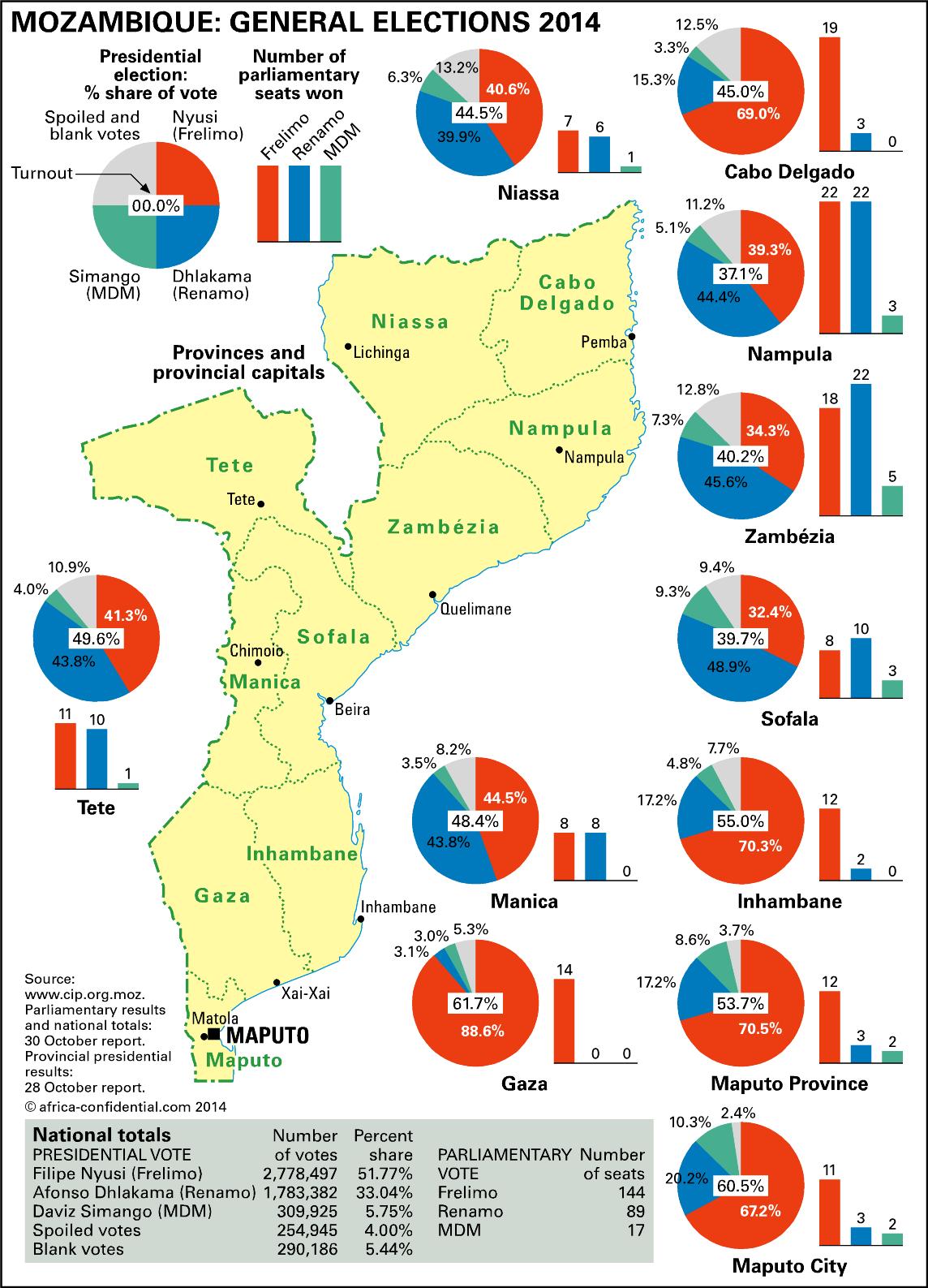
Rescuing the state finances will be one of Nyusi's greatest challenges, along with the seeminglyimpossible task of achieving lasting peace with Renamo. Buoyed by the internal conflict in Frelimo,Dhlakama seems resolved to escalate his demands. Nyusi is inclined to negotiate but there will be a limit to what he can give. Frelimo's fraud during the last elections was extremely widespread, most now agree, but Dhlakama's claims of outright victory remain implausible (AC Vol 55 No 21, Frelimo wins, Renamo revives). It is unlikely Renamo would be allowed to rule in all the provinces that voted its way and Frelimo members are not the only ones who see dangers in regional autonomy. Importantly, however, Nyusi does not have the visceral intolerance of Renamo and Dhlakama that Guebuza displayed. He could be a more reasonable and skillful negotiator. Without the intransigence born of a fear of losing face, the two sides may make better progress. The pressure on Nyusi to deliver is now great. As Guebuza found out, the disappointment of your friends can be more dangerous than the wrath of your enemies. Nyusi faces the future with immense popular good will but vast expectations, too.
Copyright © Africa Confidential 2015

http://www.africa-confidential.com

TELECOMS BILL WILL PENALISE.......

Resultado de imagem para escutas telefônicasThe government bill on telecommunications which passed its first reading in the Mozambican parliament, the Assembly of the Republic, on Wednesday is not intended to open the door to illicit wire-tapping, the spokesperson for the parliamentary group of the ruling Frelimo Party, Edmundo Galiza-Matos Junior, told reporters on Thursday.The main opposition party, the former rebel movement Renamo, had claimed that the bill might allow any official to order phones to be tapped, and for this reason voted against the bill.Speaking at a Maputo press conference, Galiza-Matos claimed that the bill went in exactly the opposite direction to that claimed by Renamo. Far from facilitating wire-taps, it increased the penalties for illicit interception of communications.The bill is an amendment of the 2004 law on telecommunications. Galiza-Matos pointed out that the clause on confidentiality of communications has been strengthened. The 2004 law states that “confidentiality is guaranteed”, but the new bill goes somewhat further, by declaring “it is obligatory to guarantee confidentiality”.The article which Renamo claimed opens the door to widespread wire-tapping, in fact increases the penalties for unauthorized wire-taps, Galiza-Matos said. If the bill is enacted into law, the penalty will be between eight and 12 years imprisonment plus a fine of up to two million meticais (about 42,500 US dollars).Wire-taps could only be authorized by “the competent authorities”. But this did not mean that any official could declare himself competent to order phones to be tapped. Galiza-Matos said that “the competent authorities” are defined in law, and that, under the current legislation, courts or the public prosecutor’s office are the bodies which can approach the regulator, the Mozambique National Communications Institute (INCM), and ask for specific phones to be tapped.

PUMA ENERGY OPENS TWO NEW TERMINALS

The international fuel distribution company Puma Energy has opened two new terminals in the southern Mozambican city of Matola. The terminals consist of eleven storage tanks holding bitumen and fuel.The facilities, which employ 77 Mozambicans, were inaugurated on Thursday by the Minister of Mineral Resources and Energy, Pedro Couto. They brings the company’s total capacity in Mozambique to 275,500 cubic metres of bitumen and fuel.According to the Chief Operating Officer for Puma Energy Africa, Christophe Zyde, “Mozambique is a very promising market in Africa today. We have confidence in the country’s long-term commercial opportunities as well as the country’s strategic location to answer the supply requirements of Southern Africa”.As a result of the new facility Mozambique will no longer rely on bitumen imports from neighbouring countries.

NYUSI CALLS FOR RESTRAINT IN DISARMING RENAMO

Resultado de imagem para NyuseMozambican President Filipe Nyusi on Thursday called for restraint in the disarming of the illegal militia of the former rebel movement Renamo.Speaking in Moamba, about 60 kilometres northwest of Maputo, during a graduation ceremony for newly trained prison guards, Nyusi put the brakes on the compulsory disarmament of Renamo, calling instead on the Renamo gunmen to hand over their weapons voluntarily.“I am using this podium to order restraint in compulsory disarmament, allowing everyone to hand over voluntarily that which they think they should not possess”, said Nyusi. “Above all, this is to allow us to work and to enter into dialogue, in the spirit of trust and mutual willingness”. “If there is no willingness on the part of all those involved in the peace process, we are aware that this peace may not happen”, he warned.“I am ready to speak with anybody, including the Renamo leadership, in order effectively to re-establish peace”, Nyusi declared. “This is so that we can find solutions that will calm Mozambicans”.He once again appealed to the Renamo militiamen to hand over their guns, “so that the ownership of weaponry is reserved only for the defence and security forces, based on a spirit of concord”.This emphasis is quite different from that given by Interior Minister Jaime Monteiro, when he addressed the country’s parliament, the Assembly of the Republic, on 4 November. Monteiro then had promised “to strengthen the collection of weapons that are in illegitimate hands”, and promised that this collection would continue “until the last firearm in unauthorized hands is collected coercively or handed over voluntarily”.Nyusi was clearly suggesting the re-opening of talks with Renamo. But it was Renamo, on the instructions of its leader, Afonso Dhlakama, which in August unilaterally broke off the dialogue with the government that had been under way since April 2013.Dhlakama himself publicly rejected the invitation from Nyusi, issued in late August, for a face-to-face meeting in Maputo. Currently Dhlakama has dropped off the radar – he has not been seen in public since 9 October, when the defence forces disarmed his bodyguards in the central city of Beira.Addressing the newly trained prison guards, Nyusi called for selfless dedication to the tasks entrusted to them. He reminded them that “the people are with you in the mission you will be carrying out as from today”. About 600 guards from all over the country graduated from the course, which lasted for six weeks.

Thursday, November 19, 2015

Triton Minerals raises funds for graphite

clubofmozambiqueTriton Minerals intends to raise 11.3 million Australian dollars through a share issue in order to continue graphite exploration in northern Mozambique, the Australian company said in a statement Thursday.Under this initiative, GMP Securities Australia agreed to issue shares of up to 4 million Australian dollars through a set of standard conditions in contracts of this kind.The funds raised will be used to further define the location of the graphite deposits in Ancuabe and in Monte Nicanda, both in the province of Cabo Delgado, northern Mozambique.The funds will also be used to extend the definitive feasibility study, to include the P66 area in the Monte Nicanda concession and the partnership with a Chinese company for construction of a graphite processing plant in Mozambique.Triton Minerals also reported that some of the funds raised are expected to be used at the beginning of construction of the processing unit, in partnership with China’s Yichang Xincheng Graphite.

Five million euros

The European Union (EU) is to donate five million euros to support the activities of civil society organizations, Deputy Minister of Foreign Affairs and Cooperation Nyeleti Mondlane announced yesterday.Speaking at the signing of the agreement in Maputo, Mondlane described the donation as "dedicated to supporting the institutional capacity of civil society organizations".Initially, 11 civil society organizations will benefit in an initiative that will fund small projects aimed at helping local communities overcome the problems they face."The program will help improve governance and citizenship in Mozambique by strengthening partnerships and mutual responsibility between public authorities, non-state participants and citizens," the Mozambican deputy minister said, praising the EU’s support of Mozambique during the 30 years of its presence in the country.Mondlane called on beneficiary organizations to give greater attention to project implementation, especially as Mozambique has "huge potential" in relation to the quality of initiatives.The head of EU delegation, Sven Kuhn von Burgsdorff, highlighted the importance of civil society for the peaceful resolution of internal conflicts at a time when the country is experiencing political and military tension, saying they were crucial in defending the interests of the population."A recently published study traces the rapid growth of Mozambican civil society and its impact on national policies, a very important element," said von Burgsdorff, adding that continuing support would strengthen their capacity to assist.

Ambassador to French Citizens in Mozambique


Message from the Ambassador to French nationals in Mozambique:
Resultado de imagem para Bruno Clerc
Today, France is in mourning. Terrorist attacks of unprecedented proportions took place in Paris last night. There are a considerable number of victims. As stated by the President of the Republic, "It is a horror. (...)This is a terrible ordeal which once again assails us. We know where it comes from, who these criminals are, who these terrorists are. What the terrorists want is to scare us. There is dread, but in the face of this dread, there is a nation that knows how to defend itself.” There is, in these tragic moments, the moment of compassion and solidarity. Our community’s thoughts go to the many victims of these cowardly attacks. There will also be time for reaction and to move on. Our country will, once again, stand up and lead the fight for freedom and democracy.
The state of emergency was declared throughout the national territory, border controls have been restored, an extraordinary cabinet meeting was convened in the night.
I want to assure you that all precautions are taken to protect our community and our operations in Mozambique. The Embassy will keep you informed of any special safety instructions: at this time, each one’s vigilance is certainly in order.
We have also received testimonies of solidarity and sympathy from many personalities: they are warmly thanked.
I invite you to reflection, solidarity, and serenity in face of these attacks that want to destabilize us. United and gathered around our values and our ideals we will know how to face this.
Long live the Republic, long live France!

Bruno Clerc

Ambassador of France in Mozambique 

Wednesday, November 18, 2015

Moatize / Macuse

It is expected in the coming days the launch of the tender for the construction of the railway line between Moatize , Tete province, and Macuse ( Zambézia ) , in central Mozambique .The chairman of Zambezia Development Corridor , Abdul Carimo , "if not arise last minute constraints the field work should start in February next year ."Abdul Carimo also said that the project also provides for ' the construction of a deepwater port in Macuse region' located in Namacurra district , " and even the implementation of a railway line about 500 kilometers" , which will end the coastal area of Sopinho in Nicoadala district , Zambezia province.The works are estimated to cost 3.5 billion US dollars and , in a first phase, will employ over 10,000 people.