The Mozambican
branch of the Coca-Cola company has just put up its prices for the second time
in just over a year.There was no public announcement, but the Coca-Cola
director of public relations and communication, Francisco Ferrao, confirmed to
the independent newssheet “Mediafax”, that the prices of some of his company’s
products rose as of 1 November.
Wednesday, November 9, 2016
COCA-COLA PUTS UP ITS PRICES

Friday, November 4, 2016
US AUTHORITIES SAY LAM CORRUPTION INVOLVED CEO

At least two Mozambican officials, including the then
chief executive officer of Mozambique Airlines (LAM), were involved in taking a
massive bribe from the Brazilian aircraft company, Embraer, according to documentation
from the United States Securities and Exchange Commission (SEC). On 24 October, the US Department of Justice issued a very summary account of
the charges Embraer faced in connection with bribes offered in four countries –
India, Dominican Republic, Saudi Arabia and Mozambique. It said the Mozambican
bribe was paid via what it described as “a false agency agreement with an
intermediary designated by a high-level official” in Mozambique Airlines (LAM).
But Embraer was also taken to court by the SEC, and the SEC complaint against Embraer is much more detailed, although, like the Justice Department, it does not name the guilty parties. On Mozambique, it gives a blow by blow account of how, between May and September 2008, Embraer negotiated the sale of two of its aircraft to LAM. The sales price was 65 million US dollars, but Embraer also ended up paying a bribe of 800,000 dollars.SEC says that “on or around 13 August 2008, a Mozambique national (referred to as the “Mozambican Agent”) told at least one senior Embraer employee that Embraer should make ‘a gesture’ to unidentified officials in the government of Mozambique when delivering the first aircraft”. The Embraer staff involved in the negotiations believed that “the Mozambican Agent was well connected with officials in the government of Mozambique”.This unnamed agent, the SEC document continues, “did not have any legitimate role” in the negotiations between Embraer and LAM: “instead, he appeared to be acting as a middleman or agent for the government officials involved in the deal, and Embraer officials believed they needed to pay the Mozambican official in order to win the contract”.So senior Embraer officials “approved an offer to the Mozambican agent of between 50,000 and 80,000 dollars per aircraft sold, even though the Mozambican agent had not rendered any legitimate services to Embraer during the negotiations”.
But this bribe was too small, and so, on or around 25 August 2008, the then LAM chief executive officer “called an Embraer sales employee and suggested that a one million dollar ‘gesture’ to the Mozambican agent would be appropriate, but that Embraer could ‘get away’ with only paying 800,000”. Then came a menacing warning – this official threatened “to torpedo the ongoing negotiations with Embraer by giving a competing bid priority over Embraer’s bid”. In other words, without the bribe there would be no sale.The threat clearly worked, since on 15 September, Embraer signed the 65 million dollar purchase agreement for the two aircraft. The official who made the threat was one of three LAM executives who signed the agreement.To make the bribe look legitimate, the Mozambican agent set up a phoney company in Sao Tome and Principe through which the bribe was channeled. SEC found that “on or around 22 April 2009, Embraer’s US-based subsidiary, Embraer RL, executed a consulting agreement with a company based in Sao Tome and Principe which the Mozambican agent controlled and which had only been incorporated in or around November 2008”.The agreement authorized this company, referred to by SEC as “the Mozambican Consultant” to promote sales of the Embraer-190 aircraft to LAM “even though the sale of such aircraft had been completed seven months earlier”. The agreement stated that “the Mozambican Consultant” had begun promoting the Embraer aircraft to LAM in March, even though “the Mozambican Consultant” did not even exist at that date.

Embraer RL then agreed to pay 400,000 dollars per aircraft – exactly the
800,000 dollar bribe mentioned in August 2008. This agreement was signed by two
Embraer executives, while “the Mozambican Agent who had initially proposed the
bribe payment as ‘a gesture’ signed the consulting agreement on behalf of the
Mozambican Consultant”. The Mozambican Consultant, the SEC found,
submitted two invoices to Embraer RL, each for 400,000 dollars, and dated 15
August and 25 September 2009. The invoices were both paid to the Mozambican
Consultant’s bank account in Portugal. SEC notes “these payments bore no
relation to any legitimate services rendered in Mozambique, and were bribes to
foreign government officials”, although in Embraer’s accounts they were
described as “Sales Commissions”.
Thursday, November 3, 2016
Gemfields and the ruby revolution in Mozambique
In
the Maninge Nice pit, the ground is literally littered with rubies. They sit in
among the dirt, throwing up glints of red and pink. We play a somewhat novel
game – who can collect the most stones in the space of a few minutes – but it’s
too easy. I get to a handful before becoming steadily distracted by the
magnitude of it all.

I
am with a group of journalists in Mozambique’s northeastern Cabo Delgado
Province, at the Montepuez Ruby Mine. Lauded as the most significant
ruby-deposit discovery of recent times, about 50 per cent of the world’s ruby
supply now comes from this mine. "Montepuez Ruby Mine covers over 33,000
hectares, making it the world’s largest ruby deposit," explains Rupak Sen,
director of marketing and sales, Asia and Middle East, for Gemfields, which
owns a 75 per cent stake in the mine. "Although the deposit was only
discovered in 2009, the rubies at the Gemfields Montepuez deposit have been
established as approximately 500 million years old."
To
boot, some of the rubies found here are of a quality previously only thought
possible in gemstones from Myanmar. "They are comparable with the
legendary ‘pigeon blood’ rubies of Myanmar, which frequently command the
highest price per carat of any coloured gemstone," says Sen.
Getting
to the mine is no easy task, of course. There are flights from Dubai to
Tanzania and then onto Pemba, on Mozambique’s northern coast – where a tiny
airport and convoluted entry process highlight the area’s limited number of
tourist arrivals – and then a lengthy drive that takes us through acres of
untamed land, past abandoned colonial-era buildings and villages made of mud
huts.
The
following morning brings expansive horizons and clear, uninterrupted blue skies
– the kind that seem specific to Africa – along with a tour of the Montepuez
Ruby Mine. It’s a revelation. The mining industry has a notoriously bad
reputation, but here we are greeted with signs such as: "Stop, think,
act" and "Safety awareness saves lives", highlighting Gemfields’
aim of operating a zero-accident mine.
Every
employee we see is appropriately dressed and equipped; and there is only
minimal visible damage to the landscape, courtesy of Gemfields’ practice of
filling in old pits as mining teams move along, replanting local plant species
to bring verdant cover back to the land. We contribute to this process during
our stay, with each member of the group planting a tree as a marker of our time
spent here.
Rubies
were first discovered in Montepuez in 2009. As the story goes, a man working
the land, which was formerly a hunting concession, happened across one of the
red stones. Given the volume of rubies that we see during our trip, it seems
incredible not that they were discovered, but that they managed to remain
hidden for so long. The local owners of the land contacted Gemfields; they had
heard about the success of the company’s ethically operated emerald mine in
Zambia and wanted to replicate the model in Mozambique. Gemfields acquired a 75
per cent stake in the mine and arrived on-site in 2012.
The
team remembers trying to decide where to place their camp. They picked a spot,
started digging a hole for the latrine and promptly unearthed handfuls of
rubies. The jokingly dubbed "million-dollar toilet" stayed, and is
now flanked by the Sort House, but the camp was moved farther away.
The
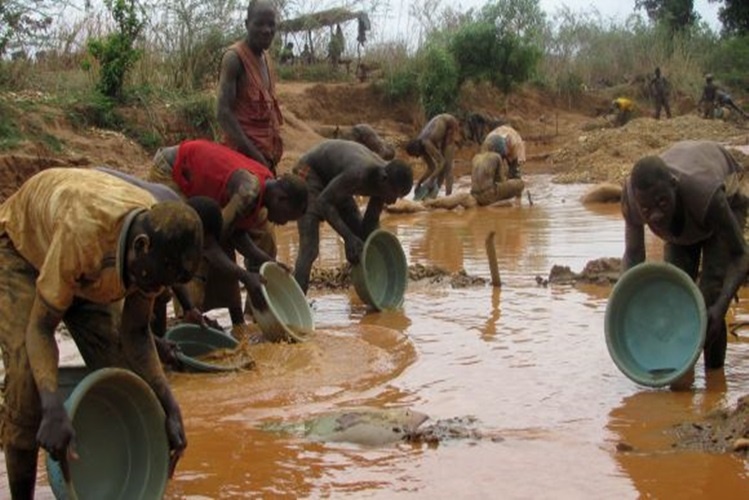
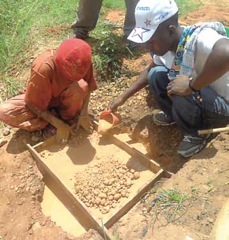
sheer number of rubies here makes the mining process relatively
straightforward. This is open-pit mining – in simple terms, mountains of rich
red earth are scooped up in enormous diggers, transported to the wash plant and
processed. The rubies are then picked out from the resultant gravel by hand.
Mining
may be a controversial business, but there’s magic in it, too. There is
something indescribable about picking up a ruby and knowing that it has sat
under the Earth’s surface for hundreds of millions of years – that you are the
first person to ever touch it.
While
diamonds have dominated the market for the best part of the past century,
rubies have been coveted by certain cultures throughout the ages. "Rubies
were treasured by early cultures as they represented the redness of the blood
that flowed through their veins, and many believed that rubies held the power
of life and so were often carried into battle for protection," says Sen.
"In fact, the ruby has always been highly esteemed in Oriental countries,
being regarded as endowed with extraordinary powers. As western empires rose to
power, rubies became the favoured gemstones of European royalty and
aristocracy.
 "However,
the advent of feisty diamond marketing, backed by consistent supply, in the
past three or four decades, took coloured gemstones to the background, while
diamonds took centre stage. This is now changing, with leading jewellery brands
like Chopard, Bvlgari, Cartier et al launching exclusive coloured-gemstone collections,
and with increasing incidence of ruby and emerald jewellery being sported by
celebrities around the world."
If
the tide is turning, Gemfields must be given its dues. It can now offer a
consistent supply of rubies to manufacturers and polishers, with the promise
that they have been ethically sourced and are of a guaranteed quality. Much as
it did with emeralds in Zambia, the company has also created the first official
classification system for rubies, which in addition to the standard four Cs (colour,
clarity, cut and carat) that will be familiar to any diamond buyer, includes
two other Cs: certification and character.
 Beyond
logistics, Gemfields’ global marketing campaigns are contributing to creating
an aura of covetability around coloured gemstones once again. Its latest
marketing campaign, Ruby-Inspired Stories, offers a triptych of films that
explore three properties that rubies have long been associated with: passion,
prosperity and protection.
In
fact, unbeknownst to many, rubies are much rarer than other precious stones. At
present, the world ruby supply consists of about three million cut and polished
carats per year, compared to about five to eight million for emeralds and 50
million for diamonds, according to Ian Harebottle, chief executive of
Gemfields.
But
the company’s aim is not for coloured gemstones to overtake or replace diamonds
in the public consciousness, but to create more balance and choice in the
market. "The decade starting 2015 was actually billed as the decade of the
coloured gemstone," says Sen, when asked whether he envisages a time when
coloured gemstones will surpass diamonds in popularity. "Every time a
consumer buys a coloured gemstone, diamonds are sold alongside. Coloured
gemstones and diamonds complement each other, and that’s the way it will always
be," he says.
 Gemfields
held its first ruby auction in Singapore in June 2014, and generated US$33.5
million (Dh123m). At its latest ruby auction in June, the company generated
record revenues of $44.3m (Dh162.7m), with an average realised price of $29.21
(Dh107) per carat.
There
is much talk during our time in Mozambique about the "1 per cent".
Not the 1 per cent, that top layer of society that holds a disproportionate
share of global wealth (although that is an unfortunate parallel) – but the 1
per cent of Gemfields’ annual revenue that it donates to CSR initiatives. The
number feels small to me – as small as it can be, almost.
I
put this point to Harebottle. "Our commitment is a minimum of 1 per
cent," he says. "We are working with a luxury good in unstable
economies. We are very fortunate that through our efforts we are constantly
growing, but there are no guarantees. When I make a commitment, I have, to the
very best of my ability, barring any major catastrophes, to be sure that I am
able to keep that commitment."
The
point, of course, is that whether you are talking about 1 per cent or 100 per
cent, sustainability needs to be sustainable, or else it is entirely
counterproductive. "When people ask me about our investment in
sustainability, I say: ‘The one thing I can tell you is it doesn’t mean we are
perfect and it doesn’t mean we are doing enough.’ I’ve lived in Africa and I
know there is not a company or individual in the world that can do enough,
because the needs are so great.
"The
one thing I do know, 100 per cent, is that the areas we are in are better for
us being there. We’re doing the best we can, recognising it’s not enough and
constantly trying to do better."
And
I am reminded on numerous occasions how even one per cent can make a major
difference in a place like Mozambique. We visit some of the projects that the
company is investing in – they are very real grass-roots initiatives.
"After collaboration with the local community, a farming association was
recently formed producing beans, okra and various other vegetables. Currently,
most of the produce is being bought back by the company, where it is purchased
at market prices and used for the sustenance of its own employees," Sen
explains. "A poultry-farming cooperative has been formed at a nearby
village with a view to further empower women in the area. Going forward,
initiatives based around education (including a new skills and development
centre), health care and the provision of clean drinking water will also be put
in place. Conservation is also a focus."
In
a perfect world, Gemfields would not be an anomaly. Its ethical approach to
mining would be the industry norm. But we do not live in a perfect world, so
Gemfields must be lauded for its efforts. It is the only supplier of coloured
gemstones that has built a holistic business model that places importance on
people and the planet, as well as profit. It is introducing transparency in an
industry where, traditionally, there has been none.For
the first time, you can buy a ruby and know exactly where it has come from, and
that it was mined in a way that is respectful of local populations. And in this
imperfect world, that’s basically priceless.
*Read
this and more stories in Luxury magazine, out with The National on Thursday,
November 3.
Wednesday, November 2, 2016
ELECTRICITY PRICES RISE
Use of more than 300 kilowatt-hours pushes the
price up steeply. Between 301 and 500 kilowatt-hours the price rises from 5.94
to 8.29 meticais per kilowatt-hour. Above 500 kilowatt-hours a month, the
increase is from 6.5 to 9.07 meticais per kilowatt hour.The preferential
household tariff is considerably lower. For the first 300 kilowatt-hours, the
price rises from 2.95 to 4.04 meticais per kilowatt hour, and between 301 and
500 kilowatt-hours a month from 4.17 to 5.72 meticais per kilowatt-hour.
Consumption in excess of 500 kilowatt-hours now costs six meticais rather than
4.38 meticais per kilowatt hour. This increase is 37 per cent.Farmers enjoy a
lower tariff. This agricultural tariff rises by only 27 per cent, from 2.68 to
3.4 meticais per kilowatt hour for the first 300 kilowatt-hours, and rising to
5.3 meticais per kilowatt hour for consumption in excess of 500 kilowatt-hours.
Consumers who use EDM’s pay as you go
electricity meters (known as Credelec) face the same percentage rises. Thus a
household using Credelec will now pay 5.14 rather than 3.75 meticais per
kilowatt-hour, while the general pre-paid tariff rises from 5.96 to 9.07
meticais per kilowatt-hour. But the pre-paid price is the same regardless of
consumption and there is no fixed rate charge.
The “social tariff” for low income domestic
consumers who use less than 100 kilowatt-hours a month remains unchanged, at
1.07 meticais per kilowatt-hour.
Speaking to reporters on Monday, the
chairperson of the EDM board, Mateus Magala, confirmed that the company’s
tariffs were about to rise. He said this was essential “in order to mobilize
resources to ensure universal access to electricity by 2030”. Magala said that,
with a general tariff equivalent to 5.3 US cents per kilowatt hour, Mozambican
electricity was the cheapest in the region. In other members of SADC (Southern
African Development Community), electricity cost 12.5 US cents per kilowatt-hour,
which made further investment possible, and this greater access to electricity.He
warned that further price increases are likely so that Mozambican electricity
prices can converge with those of the rest of the region by 2019. Magala
insisted that electricity for the poorest strata of society would continue to
be subsidized.Interviewed in Tuesday’s issue of the independent daily “O Pais”,
EDM spokesperson Luis Amado, pointed out that EDM is still selling its power
below cost. The company, he said, pays between nine and ten US cents for each
kilowatt-hour, but was then selling the power on to its clients for not much
more than half this amount. Even with the current rise in the general tariff to
7.6 US cents per kilowatt-hour “we are still below the desired level”.
“But we can’t make substantial increases all
at once”, Amado said. “It has to be gradual and we are trying to reach a tariff
that reflects the costs”.
He added that currently EDM only covers 27 per
cent of the Mozambican population. The challenge facing the company was to
reach 100 per cent. “We are still a long way from that”, said Amado, “and for
this to happen EDM must have the capacity to invest”.
EDM is facing the consequences of the
electricity price freeze that was in force from 2010 to 2015. The previous
government, under President Armando Guebuza, was faced with riots over price
rises in September 2010, and reacted with a variety of subsidies and price
freezes on essential goods and services. For five years EDM was unable to put
up its prices, despite its board repeatedly warning the government that the
situation was unsustainable and that tariffs must rise.
AGREEMENT SIGNED ON ZAMBEZIA SOLAR POWER
The
company Scatec Solar and the Norwegian Development Fund (Norfund) signed on
Monday in Maputo a contract guaranteeing the sale of solar power to the
publicly owned Mozambican electricity company, EDM, for a 25-year period.The
contract was signed at a ceremony attended by the visiting Norwegian Foreign
Minister Børge Brende and by the Mozambican Minister of Mineral Resources and
Energy, Leticia Klemens.
The project will be the first large-scale solar energy production plant in
Mozambique, and will be located in the city of Mocuba in the central province
of Zambézia. With an installed capacity of 40 megawatts it is expected to
supply 77,000 megawatt-hours per year to about 175,000 homes.
A shareholders agreement was also signed between KLP Norfund Investments AS
(22.5 percent), Scatec Solar (52.5 percent) and Electricidade de Moçambique (25
percent), involving an estimated cost of USD 84 million.The project will be
financed with USD 64 million (76 per cent) from the International Finance
Corporation of the World Bank group. The remainder will be guaranteed by the
shareholders; EDM’s part will be borne by the Norwegian government through a
grant.
Scatec Solar also reported that the financial part of the project is nearly
concluded. Construction of the solar power installation should begin in the
first quarter of 2017 and be finished in December.
Also on Monday, the Confederation of Mozambican Business Associations (CTA),
and its Norwegian counterpart, the Norwegian African Business Association
(NABA) signed a memorandum of understanding establishing a basis for business
cooperation.Under the agreement, signed by CTA chairperson Rogerio Manuel and
the deputy director of NABA, Daniella Woldemichael, the two organisations will
regularly exchange experiences in various sectors of business interest. Manuel
claimed that Norway has some similarities with Mozambique in that it is a major
producer of natural gas and an exporter of fisheries produce of worldwide
recognized merit.CTA staff, Manuel said, will visit Norway to learn from the
Norwegian experience, and Norwegian business people will come to Mozambique to
see how the CTA operates. Through these contacts the private sector in Oslo
could advise the CTA in how to improve public-private dialogue.In his visit to
Mozambique, Brende brought 30 Norwegian business people on his delegation.
MITSUI EXPECTS LNG PROGRESS BY MARCH
 The Japanese company Mitsui has announced that
it expects “certain progress” by March next year in the project to build a
plant producing Liquefied Natural Gas (LNG) in Palma district, in the northern
Mozambican province of Cabo Delgado.The company holds a twenty per cent stake
in the Offshore Area One consortium where the operator is the US company
Anadarko Petroleum. The consortium is still to make its final investment
decision (FID) on how it will commercialise the 75 trillion cubic feet of
recoverable natural gas already found in the concession.However, the news
agency Reuters reports that on Wednesday the chief financial officer of Mitsui,
Keigo Matsubara, told a press conference that the company expects “certain
progress” in the LNG project by the end of the financial year (31 March 2017).Anadarko
has a 26.5 per cent holding in Area One. In addition to Mitsui, its partners in
the consortium are ONGC Videsh and BRPL Ventures of India (20 per cent and 10
per cent, respectively), the Thai Group PTT (8.5 per cent) and Mozambique’s own
National Hydrocarbons Company, ENH (15 per cent).Initially, Anadarko plans to
produce 12 million tonnes of LNG a year, using two factories (known as
“trains”). Later it hopes to raise production to 20 million tonnes a year.
Subscribe to:
Posts (Atom)