Wednesday, November 20, 2019

BOUSTANI TAKES THE STAND IN NEW YORK TRIAL


Jean Boustani, the senior sales executive from the Abu Dhabi-based group Privinvest, on trial in New York over his role in the scandal of Mozambique’s “hidden debts” took the stand in his own defence on Monday. Boustani is facing charges of conspiracy to commit money laundering, wire fraud and securities fraud, in connection with the scheme whereby three Mozambican security-related companies, Proindicus, Ematum (Mozambique Tuna Company) and MAM (Mozambique Asset Management) obtained over two billion dollars in loans from the banks Credit Suisse and VTB of Russia, based on illicit loan guarantees issued by the government of the time, under President Armando Guebuza.
Resultado de imagem para Jean Boustani
Putting Boustani on the stand is a high risk strategy for the defence, since it exposes him to cross-examination by experienced prosecutors who have amassed a mountain of evidence backing claims that Boustani was deeply involved in paying bribes and kickbacks to Credit Suisse bankers and to Mozambican government officials, including the then Finance Minister, Manuel Chang.At the start of his testimony, according to the official transcript of the trial, Boustani categorically denied conspiring to defraud investors or conspiring to launder money.But much of what he said concentrated on how he had become involved in Africa in the first place. He claimed that the opportunity for developing a “coastal monitoring project” in Africa (the eventual justification for the three Mozambican companies) was introduced “by a friend from South Africa named Basetsana Thokoane”, nicknamed Bassey “who used to be an official in the South African secret service”.
Resultado de imagem para ematum
Whether or not this is true, it is certain that a few years earlier Thokoane had been a spokesperson for the South African Foreign Ministry – a fact Boustani seemed unaware of.Boustani claimed that, in order to handle business in Africa, “If you have to deal with the government, you need to get deal makers, usually you have brokers, middlemen — in America maybe they’re called lobbyists — to open doors, to secure for them the licenses, concessions, to execute the project.”
“I was primarily seeking to find agents to develop business in Africa,” he said, and Thokane fell into that category.He claimed that first she presented him with an opportunity in Namibia, but eventually she put him into contact with Teofilo Nhangumele, who became a key fixer for the first of the hidden loans, to Proindicus.He believed that Nhangumele was an agent of the Mozambican secret service, SISE – although there is no evidence that Nhangumele was ever employed by SISE.Boustani said he presented the Privinvest shipbuilding business to Nhangumele, and they discussed the need to protect Mozambique’s coastal resources.And at that point, the judge ended the session, since he had promised the jury they could leave at 17.00 New York time. 

Imagem relacionadaThus only when Boustani resumes giving evidence, on Tuesday, will the key evidence against him be discussed.The prosecutors do not believe Boustani was doing anything so relatively innocent as working with “brokers” or “agents”. In the previous weeks of the trial, the prosecutors have shown the jury hundreds of emails and other documents, which they regard as hard evidence of the bribes and kickbacks that Boustani and Privinvest allegedly paid, amounting to at least 200 million dollars of the loan money.Earlier in the day, the prosecutors, cross-examining a supposedly expert witness, Chuduzie Okungwu, whose expertise is in international trade and emerging markets, showed that his knowledge of Mozambique was, to put it mildly, woefully inadequate.He claimed he had relied on International Monetary fund (IMF) reports in drawing up his presentation, yet he did not know that the then head of the IMF, Christine Lagarde, had met with Mozambican officials in 2016 concerning the undisclosed loans.Until the prosecution told him, he did not even know that former SISE agent Antonio do Rosario was chairperson of Ematum, even though he had talked at considerable length about Ematum earlier in his testimony.

Did he know that Christine Lagarde had met with Rosario? No.
Did he know that Boustani and Privinvest had paid millions of dollars to Rosario in connection with the Ematum loan? No.
Resultado de imagem para ematumDid he know that Lagarde had also met with Deputy Finance Minister Isaltina Lucas, and that Privinvest and Boustani had paid her millions of dollars too? No, he did not.

Was Okungwu aware that the company Kroll had carried out an independent audit of Proindicus, Ematum and MAM? “I have not read the Kroll report”, he admitted.Okungwu did not even know that Mozambique’s highest court, the Constitutional Council had declared (in June) that the government guarantee for the Ematum bond was illegal.On Friday, Okungwu told the court that, since he does not work for Privinvest, he was charging 950 dollars an hour for his time. He claimed he had spent 100 hours on the case, and so is owed 95,000 dollars. He said he worked with six technical staff, who should be paid 900,000 dollars.So Okungwu expects Boustani to pay him close to a million dollars for his testimony. Given his inability to answer the prosecutors’ questions, it seems that Boustani is getting a poor deal for that money.

Tuesday, November 5, 2019

South Africa approaches gas ‘supply cliff’


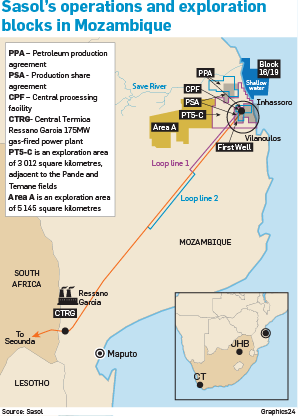
South Africa is being urged to accelerate its response to a looming natural gas “supply cliff”, which could arise in the coming four to five years unless alternative sources of supply are found to offset “tapering” imports from southern Mozambique.
Resultado de imagem para Sasol Pande and Temane 
South Africa remains highly dependent on Sasol’s Pande and Temane production areas, with the gas used both by the JSE-listed group itself to produce fuel, power and chemicals in Secunda and Sasolburg, as well as by various industrial consumers in Gauteng and KwaZulu-Natal.Although Sasol is currently exploring for additional gas in southern Mozambique, supply is currently scheduled to begin falling from 2023 onwards and the Industrial Gas Users Association of Southern Africa (IGUA-SA) is forecasting a yearly shortfall of 98-million gigajoules from 2025 onwards.The IGUA-SA has acknowledged that the pace of the decline may be delayed by a few years as a result of proposed investments by Sasol in Mozambique. Nevertheless, additional sources would still be required not only to replace dwindling Mozambican supply, but also to meet any new industrial demand.
PwC director capital projects and infrastructure James Mackay warns that South Africa currently lacks both the policy and the implementation plan to avoid, or mitigate, the potential shortfall. Speaking at the release of the latest PwC Africa oil & gas review, Mackay said that, although significant volumes of gas would become available in the region as the liquefied natural gas (LNG) export projects in northern Mozambique came on line, these volumes represented longer-term supply opportunities that would not be available in time to alleviate South Africa’s anticipated supply constraints. The impact on the country’s industrial economy could be significant, given that, besides Sasol, downstream gas industries employ some 45 000 people and produce R150-billion of economic value yearly. “Speed is more important than ever,” Mackay argued, indicating that all the supply options available to South Africa could take up to five years to implement, including the importation of LNG, which is viewed by PwC as the most feasible near-term solution. Mackay believes that an LNG import terminal at the Port of Richards Bay, in KwaZulu-Natal, represents the “lowest-cost and least-regret” option for augmenting South Africa’s gas supply by the mid-2020s.
Imagem relacionadaHe is more sceptical, however, about the commercial viability of developing the first LNG import terminal at the Coega Industrial Development Zone, in the Eastern Cape, which has been held up as government’s preferred location. Unlike Richards Bay, which has potential to immediately connect into established pipeline infrastructure linking KwaZulu-Natal with the industrial heartland of Gauteng, Coega is relatively isolated from areas of demand. Logistically, the LNG would have to be transported by either road or rail inland, before being re-gassed. This is likely to be far less cost-effective when compared with a solution that uses an existing pipeline network and is aligned to a sizeable market that will justify the initial terminal investment.
Likewise the IGUA-SA has argued that the Coega option “would be of no consequence to the current user base”. In the longer-term, the development of domestic and regional resources, including the recently discovered Brulpadda resource off the south coast and those set to arise from northern Mozambique, could offer supply-side relief. The massive finds in northern Mozambique, the PwC reviews states, have already resulted in LNG project developments worth a combined $54-billion and have the potential to turn South Africa’s impoverished neighbour into the world’s third-largest LNG exporter. Neither of these options would be on line in time to counteract the envisaged drop in supply from southern Mozambique through the Rompco pipeline to South Africa. Mackay argues that, unless a coherent solution is urgently found as to when and how the gas shortfall will be met, and by who, there is a genuine risk that a significant portion of South Africa’s industrial base, including companies such as Columbus Stainless, Consol Glass, Hulamin and Nampak will be “left stranded”.
Resultado de imagem para sasol pandeState-owned logistics group Transnet has, together with the International Finance Corporation, initiated a feasibility study into the development, by 2024, of an LNG storage and regasification terminal at the Port of Richards Bay. Nevertheless, no solution has been finalised and no procurement programme initiated. The Cabinet-approved Integrated Resource Plan 2019 (IRP 2019) has also not increased certainty, as it has reduced the demand for gas as a source for electricity to 2030, making the gas-to-power programme an unlikely anchor for the scale of gas imports required.The IRP 2019 has reduced the gas-to-power component to 3 000 MW by 2030, from the 5 100 MW outlined in the draft IRP 2018, with the bulk of that capacity expected to arise from the conversion of the diesel-fuelled peaking plant to gas over the coming ten years. “The gas volumes left in the IRP are not enough to anchor the gas infrastructure envisaged. So, we have to look more broadly than the IRP as to how to get over this gas crunch. But at the moment, there is no policy certainty with regards to who will do it, how it will be done and which port will be prioritised.”That said, Mackay is heartened by recent moves by the Department of Trade, Industry and Competition to intervene on the issue and expressed some optimism that a national gas strategy could begin to emerge as a result of that intervention.

Bombardments against insurgent positions


The Mozambican Defence Ministry has claimed further successes with artillery barrages against positions of terrorist groups in the northern province of Cabo Delgado. A release from the Ministry says that hideouts of the insurgents were bombarded on Thursday in the Gaza region, south of the Messalo river in the Cabo Delgado district of Muidumbe, and on Friday at Marere, at the mouth of the Messalo, in Mocimboa da Praia district.
Resultado de imagem para mocimboa da praia
The release gave no exact figure for casualties on either side, but said that some of the insurgents had been “neutralised”, while others had fled.
A new statement from the Ministry, issued on Sunday, claimed that there had been further artillery attacks on insurgent positions near the Messalo, in Muidumbe. This operation, it said, “inflicted considerable losses on the insurgents and many of them are now on the run”. Nonetheless, terrorist attacks are continuing. According to a Monday report in the independent newssheet “Mediafax”, on Saturday the insurgents attacked a truck travelling between Mumu and Intowe, via Mocimboa da Praia. Four of those travelling in the truck were killed in this ambush. On Friday night, terrorists attacked the village of Mbau, and burnt down several houses. Smoke was still rising from the ruins on Saturday morning.
Islamist militants in northern Mozambique attacked three vehicles last week, killing at least 23 people, according to local media reports.On Thursday the insurgents ambushed a bus with 13 people inside. The only survivor fled into the bush and ran to a village about 40km (25 miles) from the scene as the attackers set fire to the vehicle.
On Saturday, a Land Cruiser was also attacked and 10 passengers killed.Two women escaped.
Another vehicle was also attacked on Saturday, on the road heading towards the Tanzanian border. It is not known what happened to the people inside – they have not yet been found.All three attacks happened in the Mocímboa da Praia district and security forces are looking for the insurgents.