Saturday, June 20, 2020

More land rights mean fewer fires


While fires in Australia and Brazil’s Amazon have captured headlines over the last few months, half a world away and far from the media spotlight, Mozambique was similarly ablaze. The fires, combined with agricultural expansion and development, have reduced Mozambique’s forest cover by three million hectares – about 11% – from 2001 to 2018, according to the United Nations. But a pair of innovative land-rights programs, funded by the U.S. Agency for International Development (USAID) and Britain’s Department for International Development (DFID), are helping to clarify what is fueling the fires and are providing guidance on how the blazes might be battled. For years, farmer Calisto Luis Vasconcelos had a front row seat to the fires. Six times he lost his sugar cane crop to the flames.
Angola: Conflitos de terra afugentam empresários no Kwanza Norte ...
“In the past, it has been out of control,” said Vasconcelos. “You would just see a wall of fire coming toward you with no warning” In Mozambique, fires are a season problem. They are the result of traditional farming practices in which farmers burn their fields to prepare them for the next planting season. Unclear and undocumented rights to land add fuel to the fire, because when farmers have unclear and undocumented rights to their land, they tend to have conflicts with neighbours. The World Bank estimates that 90% of rural land in Africa is undocumented, so, this is a common problem. The undocumented and unclear boundaries and the slim margin for survival for many rural families are a destructive combination. Farmers often dispute boundaries with their neighbours with an eye toward claiming a few rows of their neighbour’s corn or cane for themselves. With poverty and hunger high, every row counts. These persistent disagreements over boundaries tend to sour relations between neighbours, sometimes bubbling over into outright violence. In this toxic environment, when a farmer decides to burn his or her field to make way for the next season’s crops, they may not warn a neighbour of their plans or take care to ensure that the fire does not spread.
População ignora embargo das obras em Marracuene - MozLife - O que ...
This was the case in Vasconcelos’ community. He was locked in conflict with his neighbours over his prized parcel of land – four acres of extremely fertile land down by the river. “It is a good piece of land and everyone claimed it,” said Vasconcelos. “It was mine, but everyone wanted it.” His neighbours would try to nibble away at the edges of his field, trying to get his land by taking a few rows of corn at a time. Their constant bickering meant that, in the words of Vasconcelos, “There were no rules. Things were out of control.”
And when his neighbours burned their fields, they gave Vasconcelos no warning and took no action to contain the fires to their own fields.
This began changing when DFID and USAID funded programs to help communities clarify and document their land. Working in different villages throughout the region, USAID and DFID’s partners have been teaching villagers how to use GPS-enabled tablets and to document the boundaries of each person’s fields. Farmers receive land certificates with maps of their property, a calculation of acreage, their name, and a list of community witnesses – providing documentation of their land use. Now, everyone in Vasconcelos’ village, Enhumua, has agreed on where their fields end and their neighbours’ begin.
Vasconcelos and his neighbours who have never had titles or deeds – often inheriting their land from their parents or buying it on a handshake – finally have the security of documentation that the land they farm is theirs.
Local government leaders Oliveira Pinto and Martin Gabriel Paiva said the land documentation programs were aimed at improving women’s empowerment, boosting nutrition, and reducing conflict. They have achieved those goals and brought another unexpected benefit, reducing the uncontrolled fires. “Now that the issue of land is settled, we are working together more,” said Paiva. “Now that we have recognised each other’s rights, we have changed our behaviour,” said Vasconcelos. “We respect each other.“

Arlindo Macuva is a Mozambique-based project coordinator for the NGO Oram. He works with communities across Mozambique to help them document their rights to land.

Funding for state participation

The financing for the Mozambican state’s participation in the consortium extracting natural gas in Area 1 of the Rovuma basin is “secured”, according to the president of the National Petroleum Institute (INP), Carlos Zacarias.
“Each investor must have a minimum [amount of] capital to enter the project,” Zacarias noted, and in the case of the Mozambican Hydrocarbons Company (ENH), the partners accepted a guarantee from the Mozambican state of US$2.25 billion (€2 billion), valid for five years, the INP president explained to journalists in Pemba, capital of Cabo Delgado province, where the authorities on Thursday began a two-day meeting with the Area 1 consortium, led by Total.
After that minimum capital instalment comes US$15 billion (€13.3 billion) of bank financing, recently approved, including “a component” that belongs to ENH, which, like the other participants in the consortium, is responsible for the debt.
At the moment, “work is being done on fine-tuning the financing structure” which “is already secured for all” participants in the consortium “overall”, Zacarias said.
Neither the pandemic nor the armed attacks in the surrounding area have brought into question Total’s declared goal of starting production in 2024, in the largest investment project currently underway in Africa.
Ewynza - Plataforma de Oil&Gas em Moçambique drilling wells on the seabed, the natural gas will be piped to the industrial complex now being built in the Afungi peninsula.
The coronavirus outbreak at the construction site is reported to have been resolved earlier this month, and the area today, Friday, hosted a visit by Mozambique’s minister of mineral resources and energy.
The project is to have two liquefaction plants with a combined capacity of 12.88 million tonnes per annum [mtpa], and directly linked to a jetty so that 16 special tanker ships can be filled with the liquefied natural gas (LNG).
The consortium has already closed sales contracts, mainly for markets in Asian (China, Japan, India, Thailand and Indonesia), but also in Europe, through France Electric, Shell and British Central.
An airstrip laid out alongside the plant is already operational and other infrastructure is being put in place, such as new villages to resettle those living in the area now occupied by the industrial complex.
There are also plans to build a new city in an area which is now bush, agriculture fields [machambas] and rural villages: the plan for this “gas city” comprises 1,200 hectares of residential development, 3,800 hectares for new industry associated with the LNG plant, 2,300 for agriculture, 8,000 for green areas and 214 hectares of tourist infrastructure.
Total has a 26.5% stake in the consortium, with Japan’s Mitsui having 20% and ENH 15%. Other stakes are held by India’s ONGC Videsh (10%) and its subsidiary Beas (10%), Bharat Petro Resources (10%), and Thailand’s PTTEP (8.5%).
In addition to Area 1, two others development plan have been approved in Area 4 of the Rovuma basin, led by Mozambique Rovuma Venture (MRV), a joint venture company co-owned by ExxonMobil, Eni and China’s CNPC, and which holds a 70% interest in the concession contract.
However, this consortium in April announced that it had postponed the final investment decision on its main project – the Area 4 Mamba field – which foresees the production of 15 mtpa.
The Area 4 oil companies are pressing ahead with another project to extract LNG from the Coral South reserves by means of a floating platform, intended be ready in 2022 and which will produce 3.4 mtpa.
The investments foreseen in the three Rovuma basin LNG plans will place Mozambique among the world’s leading LNG producers.

Bank denounces


The Bank of Mozambique on Friday denounced the existence of unlicensed entities that are carrying out banking activities in the country, warning society not to get involved in these practices.     “Given the growing trend in the number of entities and the denunciations that have been made, we communicate to the general public that these entities are not licensed by the Bank of Mozambique,” according to a statement from the Mozambican financial regulator.The bodies involved in these practices are not subject to central bank supervision, the note said.These entities put financial assets up for sale with the promise of monthly and quarterly interest to citizens who invest their savings.The institutions in question also promise a financial reward to anyone who can attract customers for the business, the Bank of Mozambique said.

Tuesday, June 9, 2020

Total authorised to resume activities in Afungi

The Mozambican health authorities have authorised the French oil and gas company Total to resume its natural gas activities on the Afungi Peninsula, in the northern province of Cabo Delgado.
Total heads the consortium which is building two factories in Afungi to produce liquefied natural gas (LNG). Work was interrupted in April after a outbreak of the Covuid-19 respiratory disease was detected at the Total camp. The cases in Afungi became the largest known cluster of Covid-19 cases in the country.
Since April, work at Afungi was reduced to a bare minimum, which threatened the calendar for building the LNG plants.
Speaking in Maputo on Sunday, during the Ministry of Health’s daily press conference on the Covid-19 situation, the deputy general director of the National Health Institute (INS), Eduardo Samo Gudo, announced that the outbreak in Afungi has been brought under control, “and this means that activities in Afungi can go back to normal”.
Asked about the likely date for an effective resumption of operations in Afungi, Samo Gudo replied “this is a decision that depends on the owner of the camp (i.e. Total). What we are saying is that, from an epidemiological point of view, the outbreak has been controlled”.
Of all the dozens of Total workers who were held in isolation at their quarters in the camp, all but one have been discharged. A sample from this worker is being tested, and if it proves negative, he too will be discharged.
Samo Gudo said that strict measures have been taken within the camp to avoid any possible recontamination. “Since it’s a closed area, the concern now is not to import cases”, he said. “We are witnessing an acceleration of Covid-19 cases outside the camp, but inside the camp it’s controlled”.
Measures to keep the camp free of Covid-19 had been approved by the Ministry of Health, but Samo Gudo recognised that these measures could imply additional costs. This was a situation affecting companies throughout the world and not just in Mozambique.
It was urgent, he added, “to make the transition to what is being called the new normal. That means we learn to live with this virus in a context in which strict measures are taken”.
Total is the operator of the “Mozambique LNG” project, based on the offshore gas fields in Area One of the Rovuma Basin. Total holds a 26.5per cent stake in Mozambique LNG. Its partners are Mitsui of Japan (20 per cent), PTTEP of Thailand (8.5 per cent), the three Indian companies, ONGC Videsh, Bias Rovuma Energy , and BRPL Ventures (10 per cent each), and Mozambique’s own National Hydrocarbon Company, ENH (15 per cent).

Tourism companies and workers in Inhambane


BAHIA MAR BOUTIQUE HOTEL (VILANCULOS): 424 fotos, comparação de ... Unlike tourist establishments, Hotel Baía Mar in Vilankulo decided to keep its doors open despite the crisis, but only at a cost – the hotel had to lay off much of its workforce and was left with only 30 of its previous 80 workers.
Before the COVID-19 pandemic, the hotel had a satisfactory flow of tourists, and had invested in new rooms and hired personnel to satisfy demand.
Bahia Mar Boutique Hotel - Peaks Of AfricaBut since the end of February, more than 200 reservations have  cancelled. Some of these were rescheduled for next year, but the hotel had to reimburse many customers.In order to survive, the company reached an agreement with the workers cutting the wages of those still working, but the situation is getting worse every day. Suzana Vidal says that the outlook is bleak, since there is no business, nor any concrete support from the government.

Jeremias, one of thousands without a job
‘O País’ spoke to Jeremias Júnior, one of the thousands of workers left without a job. The company he worked for decided to terminate his contract, but failed to pay any compensation.
Bahia Mar Restaurant, Vilanculos - Menu, Prices & Restaurant ...
He and other workers were presented with two proposals. The first was termination of contract with one year’s compensation but with a commitment, that as soon as the crisis passed, he would be reinstated if there was a need for additional manpower. The other proposal was definitive termination of contract without any subsequent commitment, but with all rights guaranteed. This was the option chosen by Jeremias, but he has so far come out empty-handed, since the company does not yet have the money to pay him. In order to survive, Jeremias has had to spend the savings he spent years building up. Now even his savings are running out, and he doesn’t know what July will be like. Jeremias will only receive the first instalment of compensation in October, and even so, without any guarantee.

Alcidio
Bahia Mar Boutique Hotel, Vilanculos, Moçambique, Garantia de ...Without a job, wages or savings, Alcídio Huo has to improvise in order to survive.
He worked at a tourist resort in the city of Inhambane and had his contract terminated as a result of the Covid-19 pandemic. For now, Alcídio lives on the proceeds of odd jobs, which pay him just about enough to eat.
The hotel workers’ union speaks of more than 1,400 employees put out of work, either furloughed or dismissed all together.


Nacala Logistics in Mozambique


Denmark-based towage operator Svitzer has received a five-year contract from Mozambique’s Nacala Logistics for work on the port of Nacala. The company will be responsible for the harbour towage, pilot transfer and potential salvage work at the port.
Additionally, Svitzer received a five-year extension of its contract with Egyptian LNG to provide four tugs, two mooring boats and one pilot boat to the Idku liquefied natural gas (LNG) plant. Svitzer AMEA managing director Nicolai Vinther Friis said: “We see great potential and opportunities on the African continent, and I am, therefore, very pleased that we succeeded in securing the contracts with Nacala Logistics and Egyptian LNG.
“We have had close collaboration and strong relations with both Nacala Logistics and Egyptian LNG and the contracts are of great strategic importance to us and will support our efforts and ambitions to further strengthen our presence and operations on the continent.”
Svitzer aims to ensure that its operations aid in the prosperity and growth of the communities where it operates. Friis added: “We understand that with size and scale comes responsibility, the responsibility to all those we engage with, especially our employees and customers. We, therefore, go to great lengths to ensure that our operations bring jobs and long-term prosperity to the communities in which we operate.” With the contract, Svitzer has operations in Egypt, Angola, Morocco, Liberia and Mozambique. In 2019, Svitzer signed a ten-year contract with the Suez Canal Authority, which was the second contract in Egypt. In January 2019, Schottel and Svitzer developed a new hybrid propulsion concept for use in both newbuild and retrofit vessel projects.

Accelerating from 1.5% rate in Q4


Nampula | MOZREALMozambique’s economy in the first quarter of this year was 1.7% larger than in the same period last year, marking an acceleration from the growth rate of the final quarter of last year, according to data released by the National Statistics Institute (INE). According to information released late on Monday, the year-on-year increase in the first quarter as 1.7%, up from 1.5% in the final quarter of 2019.
Activity in the agricultural sector was up 2.9%, while mining activity was down 12%. For 2020 as a whole, the World Bank estimates that Mozambique’s economy will expand by 1.3%, making it the only Portuguese-language country in Africa to escapes recession this year. For sub-Saharan Africa the institution is forecasting a 2.8% shrinkage of output, the largest such negative growth ever recorded, according to its World Economic Outlook, released on Monday in Washington.

Creates Cotton and Oilseeds Institute


Venda Macadamia em São Caetano do Sul SP à venda. Compre direto 360535 Council of Ministers this Tuesday approved the creation of a new Institute of Cotton and Oilseeds to replace the old Mozambique Cotton Institute (IAM), and the creation of the Mozambique Institute of Nuts [Instituto de Amêndoas de Moçambique] to replace the Institute for the Promotion of Cashew (INCAJU).

Minister of Agriculture and Rural Development Celso Correia said that the measures would encourage production of these crops.
Governo aprova decreto que cria o Instituto de Algodão e ...
“This decision aims to create specialty and strategic guidance for our governmental structure so that, in the next two years, Mozambique can return to producing cooking oil in a structured manner through the national production of these crops. The constitution and transformation of the Institute for the Promotion of Cashew into the Institute of Nuts was also approved in this session , expanding the spectrum of action of the institute to other nuts, with particular emphasis on the macadamia, which has been gaining traction and will hopefully represent a strategic gain for the country. It should be noted that Mozambique currently imports US$150 million of cooking oil, and the regional market is worth a billion dollars. It is our goal for Mozambique to look at other nuts, and introduce the macadamia as a family culture, generating greater income. The global nut market is worth around US$92 billion, and Mozambique has been exploring its fringes with the cashew,” Minister Correia said. The cabinet on Tuesday also approved a decree on the continued disbursement of subsidies to the victims of the Hulene dump landslide in Maputo.

War is destabilisation by competing gas producers


Jacinto Veloso lança “A Caminho da Paz definitiva”"I am convinced that we are facing a major operation whose objective is to block the natural gas projects of Cabo Delgado," writes Jacinto Veloso in Savana Friday (5 June). "We are confronted with a mega-operation of destabilisation very probably directed by a competent and powerful hub located somewhere outside the country."
MHN: SNASP"We are dealing with a mega-operation conceived, directed, and executed from outside the country to, at least, slow the natural gas projects, because they are considered a serious commercial threat to the giant economic interests of big companies involved in identical projects in the region which are competing for the same markets." He cites as a model the United States use of Islamic fundamentalists, notably Osama bin Laden, in Afghanistan from 1979 to eventually defeat the Russians. He argues that Mozambique is confronting Islamic State, not local insurgents. To respond, "prompt external help is inevitable," he argues. The Savana article (in Portuguese) is on http://bit.ly/VelosoDestab
Veloso does not say which competing gas producers are using Islamic state. The world's 8 biggest natural gas producers (in order) are USA, Russia, Iran, Qatar, Canada, China, European Union, Norway and Saudi Arabia.
Livros Ultramar - Guerra Colonial: Moçambique & FRELIMO ...
: The 83-year-old Jacinto Veloso has the standing to be taken seriously on these claims. A Portuguese air force pilot who flew his plane to Tanzania to join Frelimo in 1963, he was Security Minister (1980-83) and continued in government until 1994. He is currently a member of the government's National Defence and Security Council (CNDS). A minister during the 1982-92 war, he saw big power destabilisation first hand. He was an important back channel to apartheid South Africa and other security services, and probably retains some of those links.
da esquerda: Jacinto Veloso, Jorge Rebelo, Marcelino dos Santos e ...
And the current oil war between Saudi Arabia, Russia and the United States is real. The US promoted fracking of shale and became self-sufficient in oil and gas. There was already over-production and climate emergency concerns were curbing oil consumption. Russia refused to cut production and the Saudis hoped that by keeping up production they would bankrupt US shale producers, who are relatively expensive, and could force Russia to cut production. But Russia was also responding to US sanctions, which were partly against its oil. Prices fell from $80 to $20 in two years. Covid-19 has hit the global economy, which has made the issue worse. Gas prices have also fallen, as they are indirectly linked to oil prices.  the oil price war is also linked to hot wars. The on-going war in Libya can be seen as a proxy war between Russia, Saudi Arabia, the US and other oil producers.
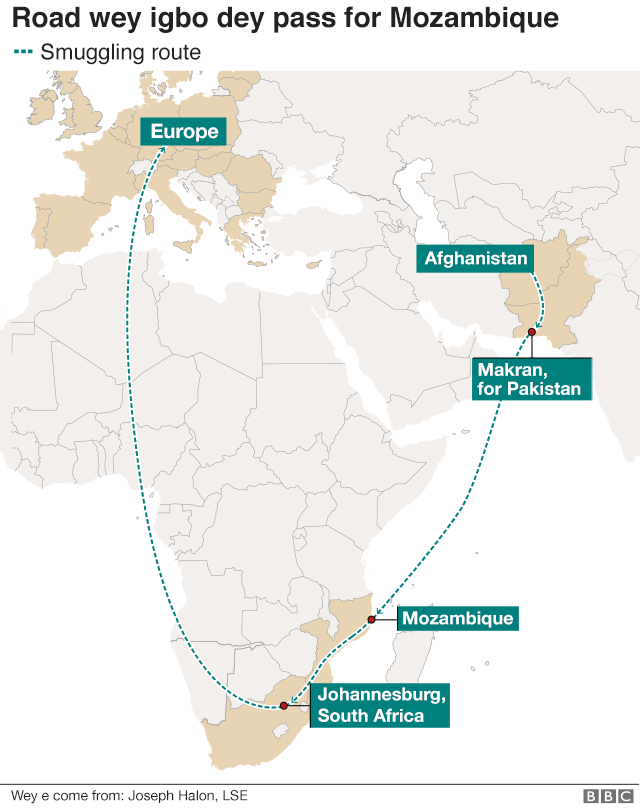
Map wey dey show road wey smugglers dey followVeloso explicitly dismisses the idea that this is an internal war based on "local discontents", and rejects the views of journalists and academics (which includes me) who argue this is mainly a domestic insurgency. Clearly destabilisation by the security services of one of the major gas producers, using Islamic State, is possible. But it does seem a stretch to suggest that the security services of any of the gas producers want to turn Mozambique into another Libya or Afghanistan.
 is not an either-or issue, as Veloso would have it. Veloso seems to have forgotten one of the key lessons of both of his wars - that outside intervention gains traction only though local discontents. All three of Mozambique's wars have been guerrilla wars in which the guerrillas had outside support, but that local support or at least tolerance was decisive. Frelimo moved south from Tanzania, with external support, and built on discontent with Portuguese colonial oppression - and won. Renamo with support of the US and apartheid South Africa, swept across Zambezia and Nampula because they were at least tolerated by rural communities who felt they had gained little from independence and were still poor. And in the north of Mozambique inequality has increased since then. When writing various books, people we talked to in the rural north had a common refrain - "my children may go to school, but my wallet is still empty." And they see an elite whose wallets are not empty and who appear to be growing fat. The independence war started in Chai, Macomia district, Cabo Delgado. The new war also started in Macomia district, with discontent at growing inequality meaning that local people at least tolerate the insurgents and do not support Frelimo, increasingly seen as new colonisers.

The supreme irony is that in the same place, Frelimo is fighting the new war in the same way the Portuguese fought the war 50 years, saying it is foreign backed destabilisation that must be defeated militarily. It did not work then, and is unlikely to work now. Helicopter gunships shooting at civilians will not defeat insurgents beheading civilians. Frelimo must win back the support of local people, and that requires dealing with the grievances and inequalities - local people must see some locals gains from the gas, rubies, graphite, heavy sands and other resources.
Even if Veloso is right and this is "mega" destabilisation by gas companies and security services, they will not be defeated by mercenaries and foreign soldiers if Frelimo does not resolve the internal inequalities and grievances.  jh

Foram as piores eleições de sempre de Moçambique″, diz ... Corp: insurgency local,despite international links

BOTH articles are on the Rand Corporation blog https://www.rand.org/blog.html in short form.

Editor: Joseph Hanlon 

Wednesday, June 3, 2020

Rizwan Adatia


Folha de Maputo - Notícias - Nacional - Resgatado patrono da ...
Eight days after his release, philanthropist and businessman Rizwan Adatia, kidnapped on April 30, met media professionals to share some details of his captivity.
In his first public statements on the issue, Adatia started by saying that he never thought that he would be a victim of this type of crime, which seemed to him to have created a whole new class of wealthy people in the country.
About his kidnapping, he said that, on the day of its occurrence (April 30), he had just left one of his offices at “Matola Jumbo” and was intercepted by two vehicles while speaking on his mobile phone. According to him, the two vehicles surrounded him and one of the occupants, who was at the wheel of one of the vehicles, ordered him to close his eyes before he was forced into one of the vehicles.
Gujarati businessman Rizwan Adatia kidnapped in Africa ...“When we arrived at my place of captivity, they put me in a bathroom. They said they wanted money and that they had unpaid debts,” said Adatia, patron of the foundation which carries his name.
In his short press conference, Rizwan praised the work of the National Criminal Investigation Service (SERNIC), adding that he never imagined that he would remain in captivity for such “a short time”.
SERNIC spokesman Leonardo Simbine said that investigations to identify those behind the kidnapping were still ongoing, while the entrepreneur himself reported that his commercial establishments had continued to function normally despite his absence.
The Rizwan Adatia Foundation has meanwhile announced that, over the next few days, it would support 10,000 families from Maputo, Gaza and Inhambane provinces with food products, a number of Mozambicans having returned from neighbouring South Africa completely without means of livelihood because of the Covid-19 pandemic.

Cumulative number of coronavirus


Mozambique today reported nine more positive Covid-19 cases,bringing the country’s cumulative total  316.. Four of the newly diagnosed cases are from Niassa province  and five from Maputo City. Three are  children. Between Tuesday (02) and Wednesday (03) 324 tests were performed in the country. Mozambique today reported 11 more recoveries, with the total of people who have fully recovered from the disease now standing at 109.
Covidttins

Energy sector caught in Southern Africa’s


By James Hall

Analysis in brief: Southern Africa’s first terrorist insurgency is casting doubt on progress to commercially exploit Mozambique’s promising natural gas deposits. Mozambique’s government has been unable to thwart the terror attacks, offering little hope for relief to multinational energy giants at work in the country.

The reaction of two of the largest oil companies at work in Mozambique, Total and ExxonMobil, to the insurgency of Islamist militants in the country’s northern Cabo Delgado province has signalled their perception of where the conflict is headed. Meeting with government authorities, the company officials did not press for a cessastion of violence that was threatening their investments, but merely for the deployment of more troops to guard their operations. Some oil installations have already been attacked. By their request for security, the oil majors were admitting there was no immediate solution to the terror operations now five years old, or their faith that government has a plan or ability to suppress the insurrection. Rather, the oil firms want protection beyond what their private security companies can provide. Clearly, they believe Mozambique is being challenged by a long-term problem; one that the Southern African Development Community has finally admitted has regional repercussions. Ironically, through their unkept promises to the people of Cabo Delgado, the energy companies are also responsible for their unsettled security situation.

An insurgency from the north takes root in Southern Africa
If energy companies are nervous about the Cabo Delgado insurgency, they require introspection regarding their own culpability. Reports have documented the disatisfaction of the region’s residents that they have not received the promised benefits of oil production and have suffered evictions, loss of livelihoods and environmental destruction. The militants have exploited these grievances to gain adherents and to prolong their insurgency. Attacks on oil infrastructure have been a distant after-thought for the Ansar al-Sunna (“Supporters of the Tradition”). The followers of Kenya’s radical cleric Aboud Rogo settled in Tanzania after his death in 2012 before moving southward one more country and appearing in Cabo Delgado in 2015. Five years before, in 2010, the US energy company Anadarko discovered a major gas reserve off the Cabo Delgado coast. Another large field was found by Italy’s ENI the following year, 2011. A rush followed as the world’s major energy companies descended upon the province with assurances that the locals would be impoverished no more. That was not to be, as local populations were evicted from ancestral lands to make way for oil and gas facilities, and jobs on a large scale failed to materlise. Meanwhile, Ansar al-Sunna announced itself by storming mosques with weaponry, declaring that the Islam practiced in Mozambique was unfaithful to their vision of the Prophent Mohammed, and that they would set up an Islamic Caliphate in the area. When local populations rejected their movement, years of brutal attacks on civilians ensued. Beheadings were the terror act of choice, and schools and clinics were targeted as being instruments of Western culture that was opposed by the extremists. Since the terror campaign against civilians began in 2017, 700 people have been killed and many more injured. Insurgents are believed to finance their activites through trade in illegal drugs and ivory.
 
People who have been displaced gather as food is distributed in Mocímboa da Praia, Cabo Delgado


Mozambique’s military, distracted by political infighting, sometimes armed, between the ruling Mozambique Liberation Front (FRELIMO) party and the perennial opposition party the Mozambique National Resistance (RENAMO), mounted a desultory counter-insurgency. The militant group’s disorganisation – Ansar al-Sunna split into as many as eight separate cells – prevented a coherent anti-state campaign but permitted attacks to continue in an ad hoc manner. Mercenaries from Somalia’s terror group al-Shabaab were hired by Ansar al-Sunna to assist with attacks, although there was no formal alliance between the two groups. Nor was ISIS an ally, at least until mid-2018 when that group announced its presence with an attack on security forces.  By this time, the counter-productiveness of bloody attacks against civilians was tacitly acknowledged by Ansar al-Sunna, which changed tactics by appealing to widespread resentment against social injustices. One of the people’s greviences – widespread youth unemployment despite the energy sector boom – was successfully exploited to recruit youth members. Portuguese, the official language of Mozambique, replaced East African Swahili as the group’s means of communication, and foreigners have been outnumbered by Mozambican members, mostly from the districts of Macomia, Mocimboa da Praia and Palma. Thus, what began as a foreign incursion into Cabo Delgado motivated by a religious agenda has now become a militant social movement. The most potent counter-insurgency, then, would be state programmes focused on reducing poverty, improving social services and providing youth employment. However, such a plan is not only difficult for an impoverished country devastated by cyclones in 2019, but is the type of massive people-oriented project that has proved beyond the ability or interest of a corruption-plagued government.

Impact on the energy sector
Several factors impacting the future of Mozambique’s energy sector are occuring at a decisive time, when energy companies must fully commit with their Final Investment Decisions (FIDs). The stakes are huge. Africa’s three largest liquid natural gas (LNG) projects are in Cabo Delgado: Total’s US$ 20 billion Mozambique LNG Project, ENI/ExxonMobil’s US$ 4.7 billion Coral LFNG Project, and the US$ 30 billion ExxonMobil/ENI/CNPC Rovuma LNG Project. Falling energy prices worsened by the Covid-19 pandemic’s drag on energy demand is a discouraging but ultimately temporary matter. Such cycles are part of the energy business. More of a wild card is the Cabo Delgado security situation, which changed for the worse as the pandemic struck. On 23 March, militants took the fight to the military for the first time, attacking police and army installations in Ocimboa da Praia and routing the security forces. Then in another reversal of its previous tactic of terrorising civilians, Ansar al-Sunna fighters distributed food to villagers. Reportedly, the gesture contributed to local populations’ more receptive attitude toward the extremist group; an attitude grounded in growing resentment of the consequences of energy exploration. Cabo Delgado citizens are seeing that what is happening to them is a repeat of what occurred in Tete Province, when 60% of the residents’ land – farms, homes, shops, whole villages – were given to coal extraction companies. Locals now know that LNG extraction is occuring offshore, offering no jobs, while pipelines and on-shore support facilities are causing mass evictions. Physical relocation or loss of access to farmlands has affected 1500 families and some 3000 fishermen have lost access to fishing grounds. Relocated farmers are given fields near or overlapping fields of existing communities, causing conflict. Fishermen have been relocated 10km away from the sea.
 
Map of LNG discoveries, where insurgency is gaining momentum


Jihadist insurgents on Africa’s eastern shores


Societal security will lead to overall security
It seems inconceivable that the large energy companies could be so insensitive to the lives of local people, or offer jobs they knew would not exist or promise poverty alleviation without any plan. If the companies were relying on government to use energy industry revenues for anti-poverty and social welfare programmes, this seems willful naivete given government’s record of corruption and fiscal responsibility that was uncovered by the International Monetary Fund at the very time energy companies were making lease deals with government. However, a hopeful sign has come from government itself. President Filipe Nyusi has admitted that Ansar al-Sunna is finding support not through religious conversion or terror but because of “poverty and unemployment.” With the military proving unable to contain the insurgency, Nyusi has turned to the SADC for help. At an Extra-Ordinary Summit of the Troika on SADC Organ on Polics, Defence and Security Cooperation in Harare on 20 May 2020, SADC leaders agreed that an attack on any member country was an attack on all countries, and condemned the Cabo Delgao terror attacks. However, no troops were committed, and the summit concluded with a plan to “study” the situation in Mozambique.
None of this augurs well for an immediate cessation of insurgent violence. The energy industry’s short-term business decisions require a stable security situation now. However, only long-term programmes aimed at ending poverty and inequity will undercut the advances Ansar al-Sunna has enjoyed in 2020, with the increasing support of ISIS.

Critical points:
  • The Islamic insurgency of Mozambique’s Cabo Delgado Province is growing after five years, threatening the country’s new and promising energy sector
  • By failing to fulfil promises to end poverty and provide jobs, energy companies have worsened social welfare conditions and have generated support for insurgents
  • Government has been unable to mount an effective counter-insurgency, and military action to achieve security for the energy sector is insufficient without addressing the fundamental problem of poverty.
The views expressed are the opinion of the author and do  not necessarily reflect the position of In On Africa.