Two
attacks
on towns in northern Mozambique by suspected jihadists point to a rapidly
deteriorating security crisis. On March 23 to 24, the centre of Mocimboa da
Praia in
Cabo Delgado
province was occupied by up to 40 “jihadists”, who targeted
government facilities, including a barracks, and brandished banners of
affiliation to the so-called Islamic State. On March 25, suspected jihadists
raided the town of Quissanga and destroyed the district police headquarters.
They too carried an Islamic State flag. Twenty to 30 members of Mozambique’s
security forces were killed in both attacks.
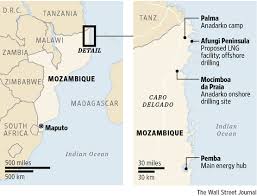
Mocimboa da Praia is just south
of the Afungi Peninsula, the location of
gas projects
worth $60- billion. Mocimboa was briefly occupied in late 2017, during attacks
claimed by a group known as
Ahlu Sunnah
Wa-Jama (or al-Sunnah) that marked the start of a brutal
low-intensity conflict, with widespread human rights abuses and
attacks on civilians. Up
to 1 000 people have now been killed and 100 000 displaced. More
recently, The Islamic State Central Africa Province (Iscap), affiliated with
the Islamic State group, has claimed responsibility for the attacks.
Video and photos of these most
recent events, along with the testimony of frightened residents and
overstretched government officials, suggest a shift of strategy by the
insurgents. There seems to have been an effort to avoid harming civilians, to
win hearts and minds by redistributing stolen food, medicine and fuel to
“loyal” residents, and to direct attacks on the state and its symbols, such as
police stations and military barracks. It is difficult from a distance to
assess if there was any genuine pleasure over these attacks among local people;
while residents in both towns that did not flee seemed to welcome the
attackers, this may well have been out of fear that the government is currently
unable to guarantee their security.
These attacks also indicate that
the jihadist-linked insurgents are growing in confidence. They are confronting
government security forces with little appetite for fighting. The Mozambican
government has been expecting setbacks like those of Mocimboa and Quissanga —
its forces are demoralised and many commanders exhausted or corrupted by an
emerging war economy.
Jihadists are also taking
tactical advantage before a reformed and more effective government
counterinsurgency effort is introduced in response. President Filipe Nyusi,
inaugurated in January for his second term, has made this crisis his prime
focus and has become the de-facto minister of defence.
Military reform and the role
of private military companies
But there is no quick fix. Most
importantly, the Mozambican military and security forces need to be
restructured. They were unable to win the Mozambican civil war (1977-1992),
even with international support, and have not improved in capacity or conduct
since. They now face a complex, multilayered and asymmetrical conflict, mostly
drawing upon local and regional grievances and networks but increasingly also
attracting some limited encouragement and advice from further afield. Nyusi
will need to build-up trusted relationships in the military in the way he has
successfully done with parts of the intelligence community.
The Mozambican government has
already reached out to international expertise — though not necessarily the
right kind. The founder of the Blackwater private military company,
Erik Prince,
supplied two helicopters and support crew for the Mozambican military in
mid-2019, before being replaced by some 170 Russian privateers linked to the
Wagner Group.
The Wagner contingent arrived in
September 2019 at Nacala airport with trucks, drones and a Mi-17 helicopter
gunship, then deployed into the combat zone of northern Cabo Delgado. Setbacks,
including at least two dead Russians, forced a tactical fallback to Nacala,
though a new effort is reported to have been underway since late February 2020.
The Mozambican government is also considering a number of proposals from other
private military companies. Maputo needs to consider these carefully; Israeli
or Gulf State involvement in any form might exasperate rather than alleviate
this crisis.

But market-led security and
military providers will not end this insurgency. Nor will the engagement of
states such as the United States, France, the United Kingdom or Angola, all of
which have made their own offers of support. What would significantly make a
difference is much closer to home: serious Tanzanian engagement. This
insurgency is concentrated in districts bordering Tanzania and there is
clear-cut intelligence of connections into Tanzania and beyond. Swahili is also
a lingua franca for the jihadists, connecting them up the East African coast,
and into eastern Congo and elsewhere.
It is puzzling, given the deep
shared history between Tanzania and Mozambique, that the bilateral relationship
is as patchy as it is today: during the liberation struggle (1965-1974) against
the Portuguese, Mozambique’s ruling party Frelimo maintained rear bases in
Tanzania, and Nyusi was educated there. Conspiracy theories circulate that
Tanzania has encouraged the Cabo Delgado insurgency to weaken its neighbour, or
at least displace radicalised individuals from Tanzanian soil into Mozambique.

President John Magafuli of
Tanzania did not attend the January inauguration of Nyusi. It has become urgent
that Magafuli (who is also the current chair of the regional body, the Southern
African Development Community) and Nyusi meet face-to-face to map out improved
intelligence sharing and a joint strategy to respond to an emerging regional
threat.
Southern Africa is locking down
because of Covid-19, which will distract the government’s ability to focus
fully on this crisis and create a perfect moment for the infant insurgency in
Cabo Delgado to grow. More military setbacks should be expected in coming
months. But the Mozambican government can still contain and prevail if it
seriously reforms its military, builds strong alliances with its regional
neighbours (especially Tanzania), chooses its private security contractors and
international partnerships wisely, and backs military efforts with better
intelligence and developmental interventions that offer alternative pathways to
potential recruits.
But despite Maputo’s hope that
significant progress will be made over the coming year, and the setting up of a
presidential task force to evaluate progress and intelligence, it is likely
that Mozambique and its partners will need to prepare themselves for a
drawn-out struggle.
Alex Vines is the director of
the Africa Programme at Chatham House
PW Botha wagged his finger and
banned us in 1988 but we stood firm. We built a reputation for fearless
journalism, then, and now. Through these last 35 years, the Mail & Guardian
has always been on the right side of history.These days, we are on the trail
of the merry band of corporates and politicians robbing South Africa of its own
potential.To help us ensure another 35
future years of fiercely independent journalism, please subscribe.


