 Mozambique on Sunday became
the fifth national team to book a place at the FIBA AfroBasket 2017 after
completing a two-game win over Zimbabwe.After beating Zimbabwe 80-68 on
Saturday, Mozambique came up even stronger outscoring the FIBA Africa Zone 6
Group H hosts 85-65.Tatenda Maturere averaged a team-high 21 points in two
games, but Mozambique’s team effort proved too much. Octavio Magolico sparked
his team with his 11.5 points per contest.In Sunday’s win, for instance,
Mozambique led by as many as 31 points before securing their 10th straight FIBA
AfroBasket appearance.They join African champions Nigeria, host Republic of
Congo, Egypt and Uganda in this year’s FIBA AfroBasket, which will run from
19-30 August.Meanwhile, Zimbabwe will have a second chance of qualifying for
Congo-Brazzaville if they beat the team that finishes second in the FIBA
AfroBasket Group G qualifier, which consists of Angola, Zambia and South
Africa.
Friday, March 24, 2017
FIBA AfroBasket 2017
Mozambique on Sunday became
the fifth national team to book a place at the FIBA AfroBasket 2017 after
completing a two-game win over Zimbabwe.After beating Zimbabwe 80-68 on
Saturday, Mozambique came up even stronger outscoring the FIBA Africa Zone 6
Group H hosts 85-65.Tatenda Maturere averaged a team-high 21 points in two
games, but Mozambique’s team effort proved too much. Octavio Magolico sparked
his team with his 11.5 points per contest.In Sunday’s win, for instance,
Mozambique led by as many as 31 points before securing their 10th straight FIBA
AfroBasket appearance.They join African champions Nigeria, host Republic of
Congo, Egypt and Uganda in this year’s FIBA AfroBasket, which will run from
19-30 August.Meanwhile, Zimbabwe will have a second chance of qualifying for
Congo-Brazzaville if they beat the team that finishes second in the FIBA
AfroBasket Group G qualifier, which consists of Angola, Zambia and South
Africa.
Dollars in undeclared
 Customs officials on
Monday arrested two Pakistani citizens in the central Mozambican province of
Manica after they were caught attempting to cross into neighbouring Zimbabwe in
possession of 424,792 US dollars in undeclared cash.The brothers, Irfan and
Rehan Majeed have both lived in Mozambique over the last 16 years and are
traders in the city of Chimoio.They were stopped as they drove into the border
post at Machipanda. Customs officials found the cash in cases and hidden inside
the car.A spokesperson for the customs service told journalists that the
arrests are the result of strengthened coordination to combat cross-border
smuggling in Manica.The brothers will be taken to court charged with committing
financial crimes.Irfan Majeed told journalists that the cash was being taken to
the Zimbabwean capital, Harare, where he intended to hand it over to its
legitimate owner. Meanwhile, Rehan claimed that he did not know anything about
the money, stating “I was only accompanying my brother … I did not know that I
was committing a crime”.
Through the exercise of citizenship
She said there has been a “qualitative leap” in the production of
basic foods in Sofala, such as maize, rice and beans, while “substantial
achievements in the management of land and of forests have also been recorded”.“We
have the resources to overcome our levels of poverty”, she said. “We can meet
the challenges of the current economic conjuncture”.The current truce, declared
by the rebel movement Renamo, had provided opportunities for increased food
production, but Taipo stressed that the term “peace” should be understood, not
just as the silencing of guns, but as “social peace”.
Chinese couple arrived by car
 Two criminals on
Wednesday evening shot a Chinese woman in the city of Chimoio, in the central
Mozambican province of Manica. The attack took place less than five hundred
metres away from the official residence of the provincial governor.Eyewitnesses
told AIM that the criminals intercepted the victim on the staircase to her
apartment as she returned home from work. The murderers shot her in the head
before taking her bag and escaping in a car.A witness told AIM, “a Chinese
couple arrived by car. We saw another car stop behind and two men get out.
Minutes later we heard two shots and the bandits returned to their car with the
handbag”.The victim was taken to hospital and there are conflicting reports on
her condition. Whilst AIM was told that she was out of danger, other reports
state that she has died.The police have opened an investigation into the crime.
In recent months violent crime involving the use of firearms in Chimoio has
fallen due to increased efforts by the police.
Shoprite in Matola
 The South African company Trans African Concessions (TRAC), which
operates the Maputo-South Africa motorway, is planning to begin roadworks to
widen the N4 from four to six lanes later this year.The work will take place
between junctions 19 and 20 – the stretch between Shoprite in Matola, past the
Maputo tollgate and on to the Jose Macamo General Hospital. This covers a
distance of 13 kilometres. The expansion will cost 28.5 million US dollars and
take two years to complete.The details of the expansion were revealed by TRAC
representative Fenias Mazive at a press conference in Maputo. He explained that
the work involves the constructing a new slow lane, enlarging bridges, laying
new pavements, and replacing street lighting. However, the work is conditional
upon the resettlement of people living in 56 houses and the removal of 16
obstacles including bars, yards, and advertising boards.Mazive revealed that
traffic along the road has reduced by 5.8 per cent to 48,000 cars per day. He
also complained about the damage caused to the road by overweight vehicles,
blaming this on the weak inspection regime.The N4 opened just under twenty
years ago. It runs from Maputo to the border crossing at Lebombo/Ressano
Garcia, then continuing on to Pretoria.
Wednesday, March 15, 2017
‘Operation Tronco’
 The government launched its ‘Operation Tronco’
forestry inspection initiative to combat illegal logging in Cabo Delgado,
Nampula, Zambézia, Tete, Manica and Sofala provinces on Wednesday.The operation hopes to trace the 700,000 cubic
meters of timber thought to be logged illegally and valued at 20 billion
meticais. Up to now, the main infringements detected by the operation have been
in the unauthorized storage, transportation and commercialization of forestry
resources.
Baía Mall
Actis, an international
private equity fund focused on emerging markets, on Friday announced a US$96
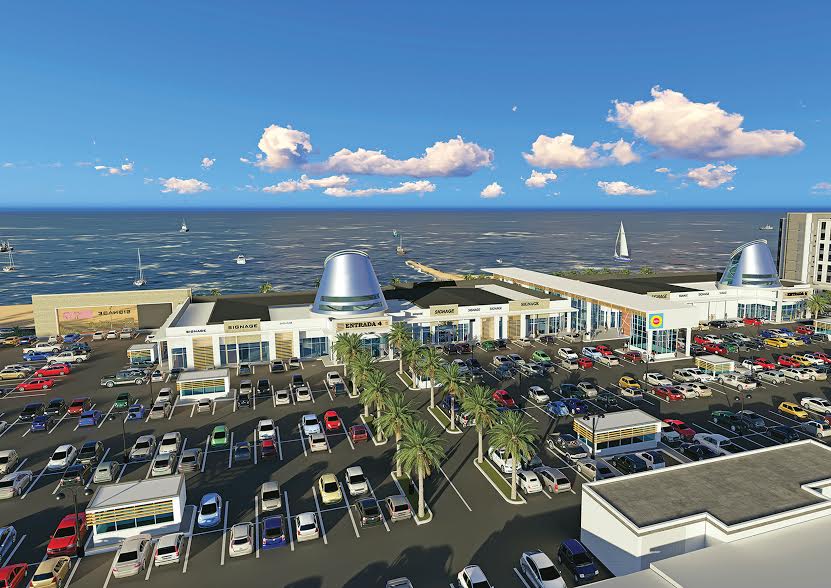
million mall investment in Maputo city.The Baia Mall, on Av.
Marginal, will have a total area of 30,000 m2 and include a hotel, more than
100 shops and restaurants, a service area and more than 900 parking spaces. It
is hoped that the project will ultimately create more than 2,500 jobs.The Baia Mall project is
promoted by ATCM (Automobile & Touring Clube de Moçambique) in partnership
with private equity company Actis and RPP Developments.

 Actis has a portfolio of more
than 200 projects in 44 countries around the world, totaling US$9 billion of
invested capital. Since 2004, Actis has invested in 11 real estate projects in
seven Sub-Saharan African countries, and has extensive experience in the
development of commercial spaces in Africa such as The Junction Shopping Mall in
Nairobi.In 2006, Actis invested in the
construction of Nigeria’s first shopping center, The Palms, followed in 2008 by
the construction of Ghana’s most up-to-date commercial and leisure space, the
Accra Mall. In 2012, Actis invested in the construction of the largest
commercial space in Kenya Garden City.
The Baia Mall will be Actis’s
first investment in Mozambique. For Louis Deppe of Actis East Africa Real
Estate, “we have long seen Mozambique as a strategic market looking for good
investment opportunities, since we believe in the country. The Baia Mall
represents a large-scale, international-level project which responds to market
needs. We will shortly announce more new investments in Mozambique”.Actis’s investments in
Mozambique are being developed in partnership with Source Capital, a private
equity ’boutique’ operating locally.

The mall will feature retail
brands such as Super Spar, Game and Woolworths. Negotiations are under way with
major national and international brands wishing to enter the Mozambican market.
At present, more than 50 percent of the commercial space is already leased in a
process that is being managed by reference real estate brokerage companies such
as Foundation Capital, Broll and JLL.The construction of the
shopping center is already under way, with more than 600 workers currently
involved. Completion is scheduled for the end of 2017.
The Nexus Between Poverty and Energy
Families of the little village
of Damo in the Moamba District, some 90 kilometers away from the capital of
Mozambique, remember the times when firewood and kerosene lamps were the only
sources of light to illuminate the interior of their homes. With World Bank
support to the Government of Mozambique’s Energy Development and Access Project
(EDAP), life in this and many other villages across the country have changed
dramatically in recent years.“My life is not the same
anymore,” said Laura Chissico, a resident of Moamba district who recalls how
life has changed for better. “Now that we have electricity, we have been able
to earn 5,000 to 7,000 MTs (about $60 to $100) a month from the sale of
‘badjias’ and other cookies. We even started to use a conventional oven that
allowed us to diversify our products and expand the business.”As many other residents in
Moamba and other districts impacted by the project─including those in the
provinces of Cabo Delgado, Niassa, Manica, and Inhambane─Laura used “xiphefo,”
a homemade unreliable kerosene lamp, as the main source of light, rendering
almost impossible any public or commercial activity at night in the district.
With investments in new distribution lines, installation of transformers as
well as new connections, her life, and those of many other rural residents
across the country, has turned around completely.José Filimone, a wood artisan
in the Maputo province, who owns a small business with over 10 workers, is
another satisfied beneficiary who tells us how his business is thriving these
days thanks to electricity. “We are now using electric tools, which means
working faster and getting better finishing quality, something that hardly ever
happened before,” he recalls visibly happy. “We have bigger orders today, and
our lives improved significantly.”
The World Bank is currently in
the second phase of a $120 million program called Energy Development and Access
Project aimed at improving access to electricity in Mozambique. As part of this
project, which is about to close, 42,500 new clients from peri-urban
settlements have been added to the network. Investments under the project
include the expansion of existing networks in fast-growing areas as well as in
large cities, including over 400 kilometers of new transmission and
distribution lines. Other areas benefiting from World Bank support are the
improvements of institutional and regulatory capacity in the energy sector, as
well as efforts to extend access to energy in rural areas through off-grid
renewable solutions such as photovoltaic solar panels installed in the
provinces of Inhambane, Manica, Cabo Delgado, and Niassa, connecting over 500 health
centers and 300 schools.
Rhino seized in Hong Kong
Wednesday, March 8, 2017
RAISE ELECTRICITY PRICES
SUBSIDY COSTS OVER 300,000 DOLLARS A DAY

AMEPETROL suggests returning to the old system
of monthly reviews of fuel prices, based on the world market price of refined
fuels and the exchange rate of the Mozambican currency, the metical, against
the dollar. Under that system, jettisoned several years ago, any variation in
market prices or the exchange rate in excess of three per cent, in either
direction, would automatically trigger adjustment of the prices paid by the
public.“Fundamentally what is happening with the fuel companies is the same as
buying something for ten meticais and selling it for five”, exclaimed the
AMEPETROL source.Fuel is cheaper in Mozambique than in all the
neighbouring countries. A litre of petrol at a Mozambican filling station costs
50.02 meticais (about 74 US cents). AMEPETROL says in South Africa, the price
is the equivalent of 73.6 meticais, in Tanzania 61.45 meticais, in Malawi 80.03
meticais, in Zambia 90.04 meticais, and in Zimbabwe 97.9 meticais.This is a
powerful incentive for motorists in neighbouring countries to drive over the
border and fill their tanks in Mozambique. The situation is particular blatant
in Manica province, where tanker trucks from Zimbabwe buy fuel and then export
it illegally to resell it, at much higher prices, in Zimbabwe.
Friday, February 24, 2017
Amnesty International Annual Report
Police incapacity
Mass graves
Death squads
Subscribe to:
Posts (Atom)