 Customs officials on
Monday arrested two Pakistani citizens in the central Mozambican province of
Manica after they were caught attempting to cross into neighbouring Zimbabwe in
possession of 424,792 US dollars in undeclared cash.The brothers, Irfan and
Rehan Majeed have both lived in Mozambique over the last 16 years and are
traders in the city of Chimoio.They were stopped as they drove into the border
post at Machipanda. Customs officials found the cash in cases and hidden inside
the car.A spokesperson for the customs service told journalists that the
arrests are the result of strengthened coordination to combat cross-border
smuggling in Manica.The brothers will be taken to court charged with committing
financial crimes.Irfan Majeed told journalists that the cash was being taken to
the Zimbabwean capital, Harare, where he intended to hand it over to its
legitimate owner. Meanwhile, Rehan claimed that he did not know anything about
the money, stating “I was only accompanying my brother … I did not know that I
was committing a crime”.
Friday, March 24, 2017
Dollars in undeclared
Customs officials on
Monday arrested two Pakistani citizens in the central Mozambican province of
Manica after they were caught attempting to cross into neighbouring Zimbabwe in
possession of 424,792 US dollars in undeclared cash.The brothers, Irfan and
Rehan Majeed have both lived in Mozambique over the last 16 years and are
traders in the city of Chimoio.They were stopped as they drove into the border
post at Machipanda. Customs officials found the cash in cases and hidden inside
the car.A spokesperson for the customs service told journalists that the
arrests are the result of strengthened coordination to combat cross-border
smuggling in Manica.The brothers will be taken to court charged with committing
financial crimes.Irfan Majeed told journalists that the cash was being taken to
the Zimbabwean capital, Harare, where he intended to hand it over to its
legitimate owner. Meanwhile, Rehan claimed that he did not know anything about
the money, stating “I was only accompanying my brother … I did not know that I
was committing a crime”.
Through the exercise of citizenship
She said there has been a “qualitative leap” in the production of
basic foods in Sofala, such as maize, rice and beans, while “substantial
achievements in the management of land and of forests have also been recorded”.“We
have the resources to overcome our levels of poverty”, she said. “We can meet
the challenges of the current economic conjuncture”.The current truce, declared
by the rebel movement Renamo, had provided opportunities for increased food
production, but Taipo stressed that the term “peace” should be understood, not
just as the silencing of guns, but as “social peace”.
Chinese couple arrived by car
 Two criminals on
Wednesday evening shot a Chinese woman in the city of Chimoio, in the central
Mozambican province of Manica. The attack took place less than five hundred
metres away from the official residence of the provincial governor.Eyewitnesses
told AIM that the criminals intercepted the victim on the staircase to her
apartment as she returned home from work. The murderers shot her in the head
before taking her bag and escaping in a car.A witness told AIM, “a Chinese
couple arrived by car. We saw another car stop behind and two men get out.
Minutes later we heard two shots and the bandits returned to their car with the
handbag”.The victim was taken to hospital and there are conflicting reports on
her condition. Whilst AIM was told that she was out of danger, other reports
state that she has died.The police have opened an investigation into the crime.
In recent months violent crime involving the use of firearms in Chimoio has
fallen due to increased efforts by the police.
Shoprite in Matola
 The South African company Trans African Concessions (TRAC), which
operates the Maputo-South Africa motorway, is planning to begin roadworks to
widen the N4 from four to six lanes later this year.The work will take place
between junctions 19 and 20 – the stretch between Shoprite in Matola, past the
Maputo tollgate and on to the Jose Macamo General Hospital. This covers a
distance of 13 kilometres. The expansion will cost 28.5 million US dollars and
take two years to complete.The details of the expansion were revealed by TRAC
representative Fenias Mazive at a press conference in Maputo. He explained that
the work involves the constructing a new slow lane, enlarging bridges, laying
new pavements, and replacing street lighting. However, the work is conditional
upon the resettlement of people living in 56 houses and the removal of 16
obstacles including bars, yards, and advertising boards.Mazive revealed that
traffic along the road has reduced by 5.8 per cent to 48,000 cars per day. He
also complained about the damage caused to the road by overweight vehicles,
blaming this on the weak inspection regime.The N4 opened just under twenty
years ago. It runs from Maputo to the border crossing at Lebombo/Ressano
Garcia, then continuing on to Pretoria.
Wednesday, March 15, 2017
‘Operation Tronco’
 The government launched its ‘Operation Tronco’
forestry inspection initiative to combat illegal logging in Cabo Delgado,
Nampula, Zambézia, Tete, Manica and Sofala provinces on Wednesday.The operation hopes to trace the 700,000 cubic
meters of timber thought to be logged illegally and valued at 20 billion
meticais. Up to now, the main infringements detected by the operation have been
in the unauthorized storage, transportation and commercialization of forestry
resources.
Baía Mall
Actis, an international
private equity fund focused on emerging markets, on Friday announced a US$96
million mall investment in Maputo city.The Baia Mall, on Av.
Marginal, will have a total area of 30,000 m2 and include a hotel, more than
100 shops and restaurants, a service area and more than 900 parking spaces. It
is hoped that the project will ultimately create more than 2,500 jobs.The Baia Mall project is
promoted by ATCM (Automobile & Touring Clube de Moçambique) in partnership
with private equity company Actis and RPP Developments.

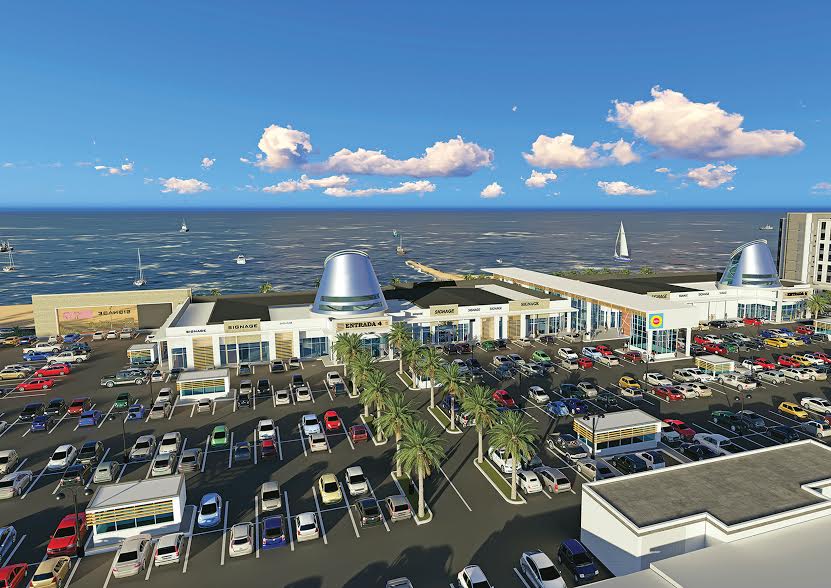 Actis has a portfolio of more
than 200 projects in 44 countries around the world, totaling US$9 billion of
invested capital. Since 2004, Actis has invested in 11 real estate projects in
seven Sub-Saharan African countries, and has extensive experience in the
development of commercial spaces in Africa such as The Junction Shopping Mall in
Nairobi.In 2006, Actis invested in the
construction of Nigeria’s first shopping center, The Palms, followed in 2008 by
the construction of Ghana’s most up-to-date commercial and leisure space, the
Accra Mall. In 2012, Actis invested in the construction of the largest
commercial space in Kenya Garden City.
The Baia Mall will be Actis’s
first investment in Mozambique. For Louis Deppe of Actis East Africa Real
Estate, “we have long seen Mozambique as a strategic market looking for good
investment opportunities, since we believe in the country. The Baia Mall
represents a large-scale, international-level project which responds to market
needs. We will shortly announce more new investments in Mozambique”.Actis’s investments in
Mozambique are being developed in partnership with Source Capital, a private
equity ’boutique’ operating locally.

The mall will feature retail
brands such as Super Spar, Game and Woolworths. Negotiations are under way with
major national and international brands wishing to enter the Mozambican market.
At present, more than 50 percent of the commercial space is already leased in a
process that is being managed by reference real estate brokerage companies such
as Foundation Capital, Broll and JLL.The construction of the
shopping center is already under way, with more than 600 workers currently
involved. Completion is scheduled for the end of 2017.
The Nexus Between Poverty and Energy
Families of the little village
of Damo in the Moamba District, some 90 kilometers away from the capital of
Mozambique, remember the times when firewood and kerosene lamps were the only
sources of light to illuminate the interior of their homes. With World Bank
support to the Government of Mozambique’s Energy Development and Access Project
(EDAP), life in this and many other villages across the country have changed
dramatically in recent years.“My life is not the same
anymore,” said Laura Chissico, a resident of Moamba district who recalls how
life has changed for better. “Now that we have electricity, we have been able
to earn 5,000 to 7,000 MTs (about $60 to $100) a month from the sale of
‘badjias’ and other cookies. We even started to use a conventional oven that
allowed us to diversify our products and expand the business.”As many other residents in
Moamba and other districts impacted by the project─including those in the
provinces of Cabo Delgado, Niassa, Manica, and Inhambane─Laura used “xiphefo,”
a homemade unreliable kerosene lamp, as the main source of light, rendering
almost impossible any public or commercial activity at night in the district.
With investments in new distribution lines, installation of transformers as
well as new connections, her life, and those of many other rural residents
across the country, has turned around completely.José Filimone, a wood artisan
in the Maputo province, who owns a small business with over 10 workers, is
another satisfied beneficiary who tells us how his business is thriving these
days thanks to electricity. “We are now using electric tools, which means
working faster and getting better finishing quality, something that hardly ever
happened before,” he recalls visibly happy. “We have bigger orders today, and
our lives improved significantly.”
The World Bank is currently in
the second phase of a $120 million program called Energy Development and Access
Project aimed at improving access to electricity in Mozambique. As part of this
project, which is about to close, 42,500 new clients from peri-urban
settlements have been added to the network. Investments under the project
include the expansion of existing networks in fast-growing areas as well as in
large cities, including over 400 kilometers of new transmission and
distribution lines. Other areas benefiting from World Bank support are the
improvements of institutional and regulatory capacity in the energy sector, as
well as efforts to extend access to energy in rural areas through off-grid
renewable solutions such as photovoltaic solar panels installed in the
provinces of Inhambane, Manica, Cabo Delgado, and Niassa, connecting over 500 health
centers and 300 schools.
Rhino seized in Hong Kong
Wednesday, March 8, 2017
RAISE ELECTRICITY PRICES
SUBSIDY COSTS OVER 300,000 DOLLARS A DAY

AMEPETROL suggests returning to the old system
of monthly reviews of fuel prices, based on the world market price of refined
fuels and the exchange rate of the Mozambican currency, the metical, against
the dollar. Under that system, jettisoned several years ago, any variation in
market prices or the exchange rate in excess of three per cent, in either
direction, would automatically trigger adjustment of the prices paid by the
public.“Fundamentally what is happening with the fuel companies is the same as
buying something for ten meticais and selling it for five”, exclaimed the
AMEPETROL source.Fuel is cheaper in Mozambique than in all the
neighbouring countries. A litre of petrol at a Mozambican filling station costs
50.02 meticais (about 74 US cents). AMEPETROL says in South Africa, the price
is the equivalent of 73.6 meticais, in Tanzania 61.45 meticais, in Malawi 80.03
meticais, in Zambia 90.04 meticais, and in Zimbabwe 97.9 meticais.This is a
powerful incentive for motorists in neighbouring countries to drive over the
border and fill their tanks in Mozambique. The situation is particular blatant
in Manica province, where tanker trucks from Zimbabwe buy fuel and then export
it illegally to resell it, at much higher prices, in Zimbabwe.
Friday, February 24, 2017
Amnesty International Annual Report
Police incapacity
Mass graves
Death squads
Maputo silence on Portuguese
Portugal’s President Marcelo Rebelo de Sousa
has repeated his enquiries into the case of the Portuguese citizen missing for
months in Mozambique, this time in writing, reports Portuguese newspaper
Público. To the disbelief of many, this has not changed the attitude of the
Mozambican authorities, the same source adds.
For months, Portugal has been asking Maputo
for information about the Portuguese citizen kidnapped in Mozambique last
summer, but the only response it has obtained so far has been silence.In the face of the long and unusual silence of
the Mozambican authorities, President Marcelo Rebelo de Sousa sent a letter two
weeks ago to his counterpart, President Filipe Nyusi, to press Maputo and, once
again, to request information about the missing man, an agricultural
entrepreneur who has worked for years in Beira, in the center of the country.To the astonishment of diplomats and
politicians following the case, President Nyusi has yet to respond to the
letter from the Portuguese head of state – more than two weeks after it was
sent.At the request of the family of the missing
businessman, the case has been handled in secrecy and with great discretion. But after seven months without information, without answers, with no signs of
an ongoing investigation or even the diplomatic courtesy of a response to the
Lisbon requests, there is clear of a development on the Portuguese side: what
began as discomfort and disillusion is giving way to disbelief and disquiet.The Portuguese contacts have been made at the
highest level: the office of the Prime Minister, the Ministry of Foreign
Affairs, the Attorney General’s Office and the Belém presidential palace have
all made formal and informal contacts, both in writing and by telephone, direct
and indirect. The result has been the same throughout: “Nothing at all,” a
source close to the matter says.
“There is no sign of life, there is no body, there is no openness to investigate,” another source who has followed the case for months complains.This silence is not only unusual in relations between friendly countries; as it is seen as particular odd since Mozambique was the destination for Marcelo Rebelo de Sousa’s first state visit in May, two months after taking office. In addition, Filipe Nyusi was one of the few heads of state that Marcelo invited to his investiture. Everyone still remembers the photographs taken that day on the balcony of the Belém Palace: the king of Spain, the former Brazilian president Fernando Henrique Cardoso and, at the center, smiling, President Nyusi. Marcelo’s relationship with Mozambique is special even at a private level. “It was the best period in the political life” of his father, Baltazar Rebelo de Sousa, Governor of Mozambique during the Estado Novo, the president wrote in a book he published a few years ago.Contacted on Friday morning and again on Saturday, the Mozambican ambassador to Portugal did not respond to Público’s request to comment on the issue. The Portuguese Foreign Minister, Augusto Santos Silva, made a brief statement to Publico: “There are cases in which families prefer that official exchanges be carried out discreetly and not publicly. This is one such case, and I will, of course, respect that wish. So I have nothing else to say.”
 Inside and outside the ministry, however,
speculation about the reason for Mozambique’s silence is deepening. One of the
most plausible scenarios is Maputo wanting to protect someone at the top of its
own hierarchy, in the police or the administration itself. “In Mozambique,
there are no decisions taken at the intermediate level,” a deep knowledge of
the country’s suggests. “It’s all at the top level.”The kidnapping of the Portuguese businessman,
at the end of July 2016, is unusual in a variety of ways and does not follow
the classic pattern. There was a first contact by the kidnappers but there was
never a request for a ransom (as a rule, this happens in the first 48 hours, at
most 72 hours after the disappearance of the victim), and the abduction did not
occur in Maputo, but in Gorongoza, where Renamo has its bases.
There have been abductions in Mozambique for
years and direct links between the kidnappers’ networks and the Mozambican
police have been known for years. Between 2001 and 2013, there were more than
60 abductions in the country, but it was from 2011 that the problem
intensified. At the end of 2013 alone, there were there 30 kidnappings in six
weeks. At that time, a Maputo court sentenced three policemen to 16 years in
prison for involvement in abductions, and shortly afterwards two more police
officers were arrested on suspicion of the same crime. “There are police
officers in court because of involvement in the kidnappings, but it’s always
the small fry,” says a Portuguese businessman. “There are cases where people
are kidnapped by the police and released by the police and it is clear that it
is all the same people.”
French confidence still high in Mozambique
 “We’re starting to see a few positive signs,”
French ambassador to Mozambique Bruno Clerc noted at a cocktail dinner held
yesterday at the Résidence de France and organized by the European Business
Club (EBC) in Maputo. The diplomat said that he felt somewhat “reassured” by
recent measures taken by the Mozambican authorities to curb the current
economic and financial crisis that has been stifling the country for almost two
years.Mozambique’s economic growth slowed to 3.3
percent in 2016 (a 15-year low) after growing more than 6.5 percent the
previous year. Its currency, the metical, has lost more than 140 percent of its
value against the dollar since October 2014. The government said last month
that it would unable to honor its commitments to repay bondholders following a
scandal over undisclosed debts of more than US$2 billion not approved by
parliament.
Last December, the central bank of Mozambique
decided to increase its main benchmark interest rates by 150 basis points to
9.75 percent, in order to offer the metical some support. It also introduced a
new interest rate for the interbank money market, with effect from 15 April,
called the monetary policy rate. “It is still too early to appreciate the
impact that those measures will have on the Mozambican economy in 2017”, Clerc
said in an exclusive interview for Club of Mozambique. “However we are
confident that 2018 will show some tangible signs of recovery.”In its most recent forecasts, the Economist
Intelligence Unit (EIU) expects significant private investments in the
construction and services sectors from 2018 on, while mega gas projects in the
northern part of the country are expected to start next year. Economists
anticipate that Mozambique will grow at an average rate of 5.1 percent between
2018 and 2021, a number still below the 7.5 percent recorded between 2005 and
2015.
 After having maintained its SD (Selective
Default) rating on Mozambique’s currency, S&P Global Ratings explains that
the development of large coal and natural gas fields will be key for
medium-term economic growth. “Much of the rail track to new coal deposits has
been laid (previously a key constraint to exports), which should support higher
coal production over 2017-2020, provided international prices do not fall
steeply,” the rating agency wrote in a report published two weeks ago.However, French interests in Mozambique go
beyond the mere commodity sector. Testing, inspection and certification
specialist Bureau Veritas has a strong presence in Mozambique – in seven
locations, according to the Mining Review, while Seagram’s gin, Havana Club rum
and Chivas Regal Scotch producer Pernod Ricard established itself here in 2015,
the same year the multinational banking and financial services company Société
Générale opened an office in Maputo.France-Mozambique Business Club’s (FBC)
General Manager Audrey Gortana Vallet notes that about a hundred French
companies and subsidiaries are currently operating in Mozambique, employing a
significant number of employees. “Around 10,000”, Vallet says. “These companies
operate in the transport, logistics, energy, construction, services, electrical
equipment and primary sectors,” the FBC chairwoman adds.
The FBC was founded in 2015 and offers various
services to French companies already established in Mozambique as well as to
those eager to expand into this southern African market. It was recently
appointed to the rotating presidency of the EBC for 2017, and Vallet will now
succeed Club of Mozambique’s president and Swiss investor Adrian Frey as
chairman of the EBC.There is still plenty of room left for French
companies, as the French presence in Mozambique remains very low compared, for
example, to the Portuguese’s. “There are only 743 French citizens living in
Mozambique,” confirms Yanis Bouchard Pereira, Economic Cooperation Officer at
the Club Export Reunion and member of the French-Mozambique Club, who also
attended the cocktail dinner.
 Asked what the main benefits that French
businesses could offer Mozambique were, Clerc stressed technological transfer.
“Offering professional and technical training for local employees, thus
promoting the emergence of new skills, is at the core of French investment
philosophy,” he says.While this may translate into higher prices
for the services and goods provided by those companies such an approach is far
more beneficial for the country in the long term. A training program in the
field of labor inspection in the mining sector, which will provide increased
safety for Mozambican workers, is currently taking place with French
assistance.Launched in 2015, the EBC is a joint
initiative of the European business chambers to promote business and
investments in Mozambique. Its members consist of business clubs and economic
and trade offices from various embassies, including Switzerland, Italy,
Germany, Netherlands, Finland, Spain, Portugal and United Kingdom.
Representing about 600 European companies, the
EBC aims to extend the local business network, not only with the objective of
helping those intent on establishing their own businesses, but also with that
of partnering with existing local operators. The mutual interactions of its
members form a communication platform through which they can develop collective
responses to various challenges.
The platform is also the main communication
medium between EBC representatives and the Mozambican government. The FBC’s new
chairman will address the task of organizing all the EBC held during her
mandate. “While it is true that members may be competitors, the EBC allows them
to join forces on common projects, where each is complementary to the other,”
the French ambassador explains. “As such, the club creates a win-win situation
for all participants.”The cocktail dinner was sponsored by
international audit and consulting group Mazars, the global logistical leader
DHL, Société Générale and Pernod Ricard among others. All participants at the
evening contributed to a fundraising program in support of two charity
projects: the ‘Wamina Girl” project, which helps young Mozambican girls in the
management of their menstrual cycle, and non-governmental organization ASAS’s
Alulamile Orphanage project, which finances the construction of bathrooms and
toilets.
Facilitates granting of visas
The
government of Mozambique has approved a regulation to facilitate the granting
of entry visas to foreign nationals engaged in investment activities, thus
contributing to improving the business climate, the deputy minister of Culture
and Tourism said on Tuesday in Maputo.
 Quoted by Mozambican news agency AIM, Ana
Comoana said the approved document reduces the minimum amount to grant the
Investment Activity visa from US50 million to US$500,000.“If the amount
required is high there will be few people who will invest in Mozambique but if
it is smaller it is likely that in return the number of investors will
increase,” she said. Comoana said after the meeting of the Council of Ministers
that the regulations also intend to facilitate the movement of foreign tourists
in the country, using the border visa, valid for 30 days with the right to two
entries.The deputy minister of Culture and Tourism said that to date the border
visa was reserved for natural foreign citizens of a country that did not have
diplomatic representation in Mozambique.The approved regulation makes it
possible to “stimulate tourism to Mozambique and as a result, also encourages
investment in the tourism sector, which will have to respond to this increase
in visits,” she said, cited by news agency AIM.The deputy minister of Culture
and Tourism said that 1.6 million tourists are expected to visit Mozambique in
2017.
Subscribe to:
Posts (Atom)